
AI-Driven Software Development Workflows
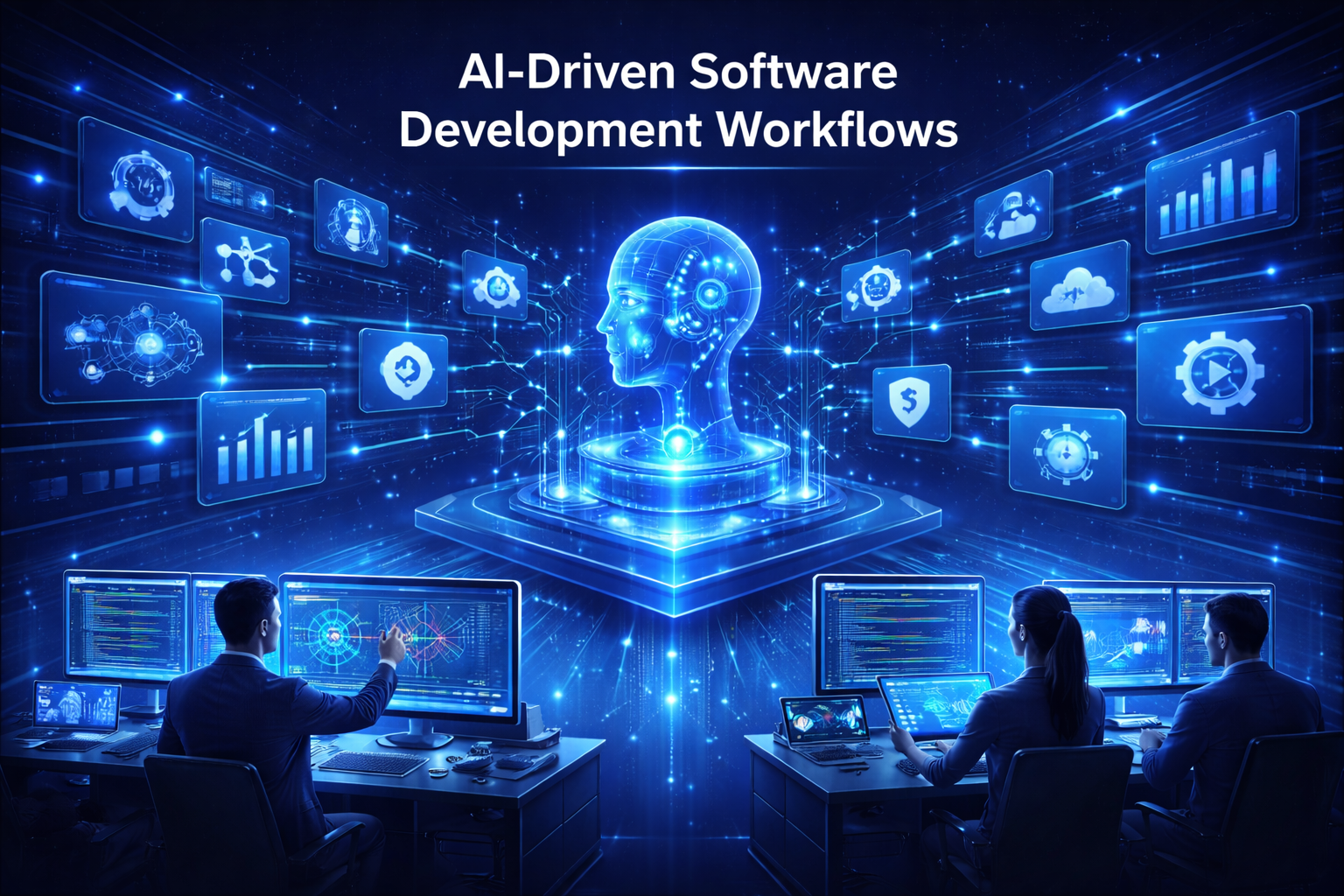
Introduction
Software development is evolving rapidly. Traditional development workflows—while effective—are often limited by manual processes, fragmented tools, and slow feedback loops.
In 2026, organizations are adopting AI-driven software development workflows to accelerate delivery, improve code quality, and enable smarter decision-making across the development lifecycle.
From code generation to automated testing and deployment, AI is transforming how software is built, tested, and maintained.
At APISDOR, we help enterprises design AI-driven development workflows that enhance productivity, scalability, and innovation.
What Are AI-Driven Software Development Workflows?
AI-driven workflows integrate artificial intelligence into every stage of the software development lifecycle (SDLC).
This includes:
AI-assisted coding and code generation
Intelligent testing and QA automation
Predictive DevOps and CI/CD optimization
Automated documentation and knowledge management
Real-time monitoring and issue resolution
These workflows reduce manual effort and enable continuous improvement across development processes.
Why AI-Driven Development Matters in 2026
1. Faster Development Cycles
AI tools can:
- Generate boilerplate code
- Suggest improvements in real time
- Automate repetitive tasks
This significantly reduces development time.
2. Improved Code Quality
AI-driven systems:
- Detect bugs early
- Recommend best practices
- Enforce coding standards
This results in more reliable and maintainable code.
3. Enhanced Developer Productivity
Developers can:
- Focus on complex logic and innovation
- Reduce time spent on routine tasks
- Collaborate more effectively
AI acts as a co-pilot for developers.
4. Smarter DevOps and Deployment
AI optimizes:
- CI/CD pipelines
- Deployment strategies
- Resource allocation
This ensures faster and more reliable releases.
Key Components of AI-Driven Workflows
1. AI-Assisted Coding
Tools provide:
- Code suggestions and auto-completion
- Refactoring recommendations
- Natural language-to-code capabilities
2. Intelligent Testing and QA
AI enables:
- Automated test case generation
- Predictive defect detection
- Continuous testing pipelines
3. AI-Enhanced CI/CD Pipelines
AI improves:
- Build optimization
- Deployment success rates
- Rollback and recovery mechanisms
4. Observability and Monitoring
AI-driven monitoring systems:
- Detect anomalies
- Predict system failures
- Trigger automated remediation
5. Documentation and Knowledge Management
AI automates:
- Code documentation
- Knowledge base updates
- Developer onboarding processes
AI Across the Software Development Lifecycle
| SDLC Stage | AI Impact |
|---|---|
| Planning | Requirement analysis and estimation |
| Development | Code generation and optimization |
| Testing | Automated testing and bug detection |
| Deployment | Intelligent CI/CD pipelines |
| Maintenance | Predictive monitoring and fixes |
AI transforms the SDLC into a continuous, intelligent cycle.
Enterprise Use Cases
- SaaS Product Development: AI accelerates feature delivery and improves scalability.
- DevOps Automation: AI optimizes infrastructure management and deployment workflows.
- Legacy System Modernization: AI helps refactor and modernize existing codebases.
- AI-Driven Product Innovation: Organizations build products with AI embedded into development workflows.
Benefits of AI-Driven Development
| Benefit | Impact |
|---|---|
| Speed | Faster development cycles |
| Quality | Reduced bugs and errors |
| Efficiency | Automated workflows |
| Scalability | Handles complex systems |
| Innovation | Enables advanced product features |
AI-driven workflows turn development into a smarter, faster, and more adaptive process.
Challenges to Consider
- Over-reliance on AI-generated code
- Data privacy and security concerns
- Integration with existing tools
- Skill gaps in AI adoption
These challenges can be managed with proper governance and training.
Best Practices for Implementation
- Start with AI-assisted coding and testing
- Integrate AI into CI/CD pipelines
- Maintain human oversight for critical decisions
- Ensure secure and compliant AI usage
- Continuously evaluate and optimize workflows
AI should augment—not replace—engineering expertise.
How APISDOR Enables AI-Driven Development
At APISDOR, we help enterprises:
- Design AI-driven development pipelines
- Integrate AI tools into DevOps workflows
- Build scalable, cloud-native architectures
- Implement monitoring and governance frameworks
- Optimize development processes for performance and ROI
We focus on delivering efficient, high-quality software development ecosystems.
Frequently Asked Questions
Q1. Can AI replace developers?
A: No. AI enhances developer productivity but does not replace human expertise.
Q2. Is AI-generated code reliable?
A: It can be, but it should always be reviewed and validated by developers.
Q3. How quickly can AI improve development workflows?
A: Many organizations see improvements within weeks of adoption.
Q4. Is AI-driven development secure?
A: Yes, with proper governance, access controls, and monitoring.
Q5. What is the first step to adopting AI-driven workflows?
A: Start with AI-assisted coding and testing tools, then expand gradually.
Conclusion
AI-driven software development workflows are redefining how modern applications are built. By integrating AI into every stage of the development lifecycle, enterprises can achieve faster delivery, higher quality, and greater innovation.
In 2026, organizations that adopt AI-driven workflows will lead the way in software development efficiency and scalability.
With APISDOR as your partner, you can build intelligent, future-ready development pipelines that drive business success.


