
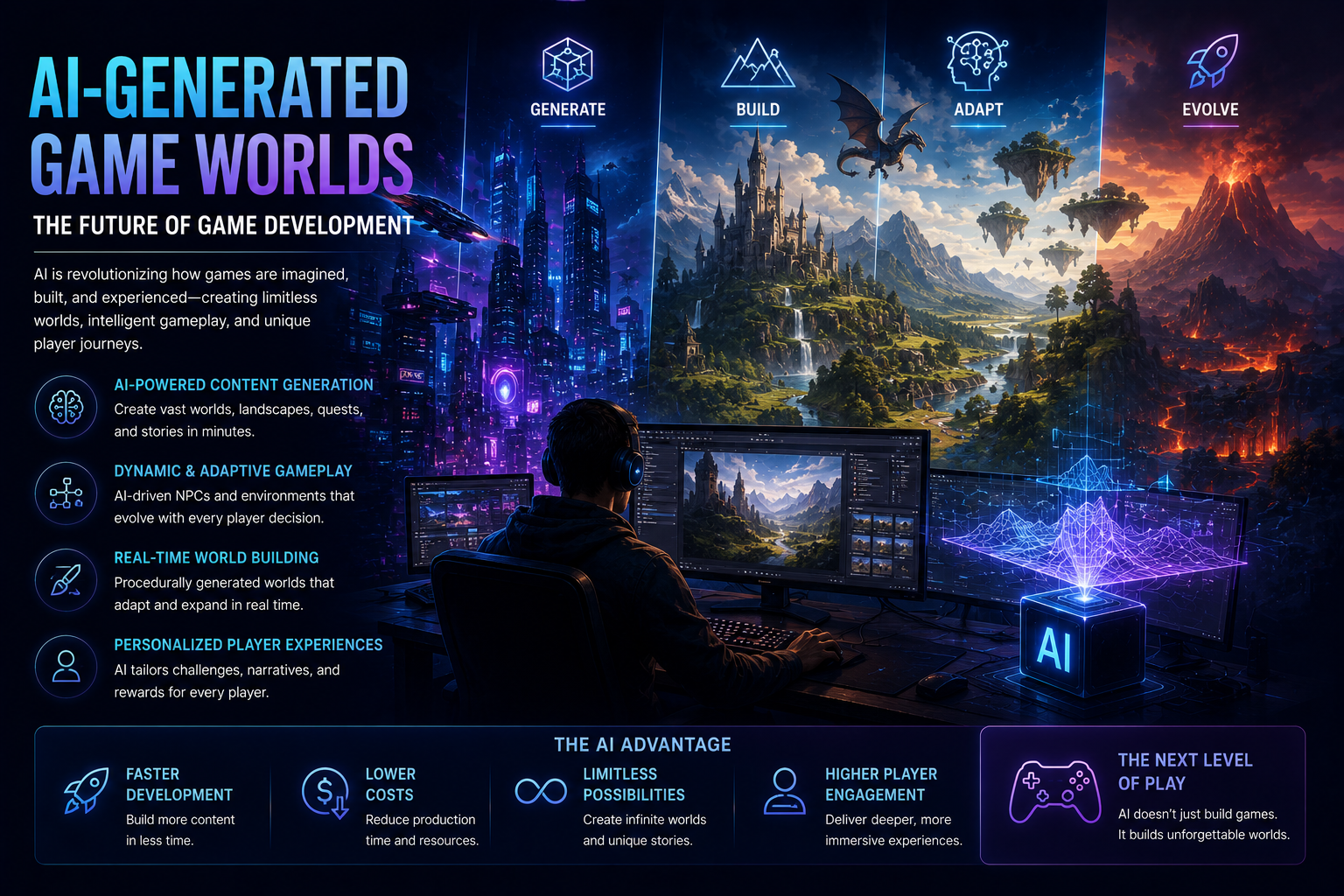
AI-Generated Game Worlds The Future of Game Development
Introduction
The gaming industry is entering a new era where Artificial Intelligence (AI) is transforming how games are designed, developed, and experienced. Traditionally, creating expansive game worlds required years of work from designers, artists, writers, and developers. Today, AI is helping studios generate dynamic environments, intelligent NPCs, adaptive storylines, and immersive gameplay at an unprecedented scale.
In 2026, AI-generated game worlds are redefining game development by enabling developers to create richer experiences faster while reducing production costs and increasing creative possibilities.
At APISDOR, we believe AI is not replacing game developers—it is empowering them with intelligent tools that accelerate innovation and unlock new levels of creativity.
What Are AI-Generated Game Worlds?
AI-generated game worlds are virtual environments created or enhanced using artificial intelligence instead of relying entirely on manual design.
AI can generate:
- Landscapes and environments
- Cities and villages
- Characters and NPCs
- Storylines and quests
- Dialogues
- Sound effects and music
- Dynamic game events
Rather than building every asset manually, developers use AI to generate, customize, and refine content while maintaining creative control.
Why AI Is Transforming Game Development
1. Faster World Building
Creating large open-world games traditionally takes years.
AI accelerates:
- Terrain generation
- Environment design
- Asset placement
- Level creation
This significantly reduces production time.
2. Unlimited Content Generation
AI enables developers to create:
- Infinite maps
- Endless quests
- Procedurally generated missions
- Dynamic ecosystems
Every player’s experience can become unique.
3. Smarter NPCs
Modern AI allows non-player characters (NPCs) to:
- Remember previous interactions
- Respond naturally
- Adapt to player behavior
- Make independent decisions
This creates more realistic and engaging gameplay.
4. Personalized Gaming Experiences
AI analyzes player behavior to adjust:
- Difficulty levels
- Story progression
- Rewards
- Challenges
This ensures every player enjoys a customized experience.
Key Technologies Behind AI-Generated Games
Generative AI
Generative AI creates:
- Game environments
- Character designs
- Animations
- Dialogue
- In-game assets
Developers can rapidly prototype entire game worlds.
Machine Learning
Machine learning enables games to:
- Learn player behavior
- Improve NPC intelligence
- Predict player preferences
- Optimize gameplay experiences
Procedural Content Generation (PCG)
AI-powered procedural generation creates:
- Randomized maps
- Dungeons
- Cities
- Forests
- Space environments
This dramatically increases replay value.
Natural Language Processing (NLP)
NLP enables NPCs to:
- Hold realistic conversations
- Understand player commands
- Generate contextual dialogue
Players experience more immersive storytelling.
Computer Vision
AI can assist in:
- Character animation
- Motion analysis
- Object recognition
- Environmental interactions
This improves realism within game worlds.
How AI Is Changing the Game Development Workflow
Concept Design
AI helps artists generate:
- Environment concepts
- Character ideas
- Weapon designs
- Fantasy worlds
This speeds up creative brainstorming.
Asset Creation
AI can generate:
- 3D models
- Textures
- Animations
- Background environments
Artists then refine these assets rather than creating everything from scratch.
Storytelling
AI assists writers by generating:
- Side quests
- Character dialogue
- Branching storylines
- Dynamic narratives
Stories become more interactive and personalized.
Game Testing
AI automates:
- Bug detection
- Gameplay testing
- Performance analysis
- Balance testing
This reduces development time while improving quality.
Live Game Operations
AI analyzes player behavior to:
- Recommend updates
- Detect cheating
- Balance gameplay
- Improve player retention
Live-service games benefit significantly from AI insights.
Enterprise Benefits of AI in Game Development
| Benefit | Business Impact |
|---|---|
| Faster Development | Reduced production timelines |
| Lower Costs | Less manual asset creation |
| Higher Creativity | More time for innovation |
| Better Player Experience | Personalized gameplay |
| Increased Replayability | Dynamic game worlds |
| Scalability | Larger and richer game environments |
AI helps studios produce more content without proportionally increasing development costs.
Real-World Use Cases
Open-World RPGs
AI generates:
- Massive landscapes
- Dynamic NPC interactions
- Personalized quests
Creating living worlds that evolve with player actions.
Survival Games
AI dynamically creates:
- Weather systems
- Wildlife behavior
- Resource distribution
- Environmental events
Every gameplay session feels unique.
Strategy Games
AI improves:
- Enemy tactics
- Resource management
- Adaptive difficulty
- Intelligent simulations
Players experience more challenging opponents.
Multiplayer Online Games
AI powers:
- Matchmaking
- Anti-cheat systems
- Dynamic events
- Community moderation
Improving fairness and engagement.
Mobile Games
AI personalizes:
- Progression systems
- Rewards
- User retention campaigns
- Difficulty balancing
This enhances long-term player engagement.
Challenges of AI-Generated Game Worlds
Maintaining Creative Quality
AI-generated content still requires human designers to ensure consistency, artistic direction, and narrative quality.
Ethical Considerations
Studios should address:
- Copyright and ownership of AI-generated assets
- Responsible use of training data
- Transparency around AI-generated content
Clear policies help build trust with creators and players.
Performance Optimization
Large AI-generated environments require:
- Efficient rendering
- Optimized storage
- Intelligent resource management
Balancing quality with performance remains important.
Human Creativity Remains Essential
AI supports developers but cannot replace:
- Creative direction
- Emotional storytelling
- Artistic vision
- Gameplay innovation
The best results come from collaboration between AI tools and experienced development teams.
Best Practices for Using AI in Game Development
- Use AI as a Creative Assistant
Allow AI to accelerate production while keeping designers and writers in control of the creative vision. - Combine Procedural Generation with Human Review
Review and refine AI-generated environments to maintain consistency and quality. - Prioritize Player Experience
Use AI to enhance gameplay rather than simply increasing content volume. - Build Ethical AI Workflows
Respect intellectual property, document AI usage, and ensure transparency throughout development. - Continuously Improve AI Models
Analyze player feedback and gameplay data to refine AI systems over time.
How APISDOR Helps Build AI-Powered Gaming Solutions
At APISDOR, we help gaming companies:
- Develop AI-powered game platforms
- Integrate Generative AI into development workflows
- Build intelligent NPC systems
- Design scalable cloud-based gaming architectures
- Implement AI-driven analytics and personalization
- Create secure and high-performance gaming ecosystems
Our expertise enables studios to accelerate game development while delivering engaging, immersive player experiences.
FAQs: AI-Generated Game Worlds
Q1. Can AI create an entire game without developers?
A: No. AI can generate assets, environments, and dialogue, but human developers are still essential for creative direction, gameplay design, quality assurance, and overall production.
Q2. Will AI replace game designers?
A: No. AI enhances productivity by automating repetitive tasks, allowing designers to focus on creativity, storytelling, and player experience.
Q3. How does AI improve NPC behavior?
A: AI enables NPCs to respond dynamically to player actions, remember interactions, adapt their behavior, and create more natural conversations.
Q4. Are AI-generated games more expensive to build?
A: Not necessarily. While AI tools require investment, they often reduce production time and asset creation costs, leading to greater efficiency over the course of a project.
Q5. What types of games benefit most from AI-generated worlds?
A: Open-world RPGs, survival games, simulation games, strategy games, sandbox games, and multiplayer online games all benefit from AI-generated environments, adaptive gameplay, and intelligent NPCs.
Conclusion
AI-generated game worlds are transforming the future of game development by enabling studios to build larger, smarter, and more immersive experiences in less time. From procedural environments and intelligent NPCs to adaptive storytelling and personalized gameplay, AI is becoming a powerful creative partner rather than a replacement for human talent.
As the gaming industry continues to evolve, developers who combine AI innovation with strong artistic vision will be best positioned to create memorable experiences that captivate players around the world.
With APISDOR as your technology partner, you can harness AI to build scalable, intelligent, and next-generation gaming solutions that redefine interactive entertainment.


