
Workflow Intelligence Platforms Using AI + APIs
Introduction
Modern enterprises manage thousands of workflows every day—from customer onboarding and financial approvals to IT operations and supply chain management. While traditional workflow automation has helped streamline repetitive tasks, it often relies on predefined rules that cannot adapt to changing business conditions.
In 2026, organizations are moving beyond conventional automation by adopting Workflow Intelligence Platforms powered by Artificial Intelligence (AI) and APIs. These platforms combine intelligent decision-making, real-time data, and seamless system integration to create adaptive workflows that continuously optimize business processes.
Instead of simply automating tasks, workflow intelligence platforms analyze data, predict outcomes, recommend actions, and coordinate processes across enterprise systems with minimal human intervention.
At APISDOR, we help enterprises build AI-driven workflow platforms that connect applications, automate operations, and enable smarter business decisions through modern API-first architectures.
What Is a Workflow Intelligence Platform?
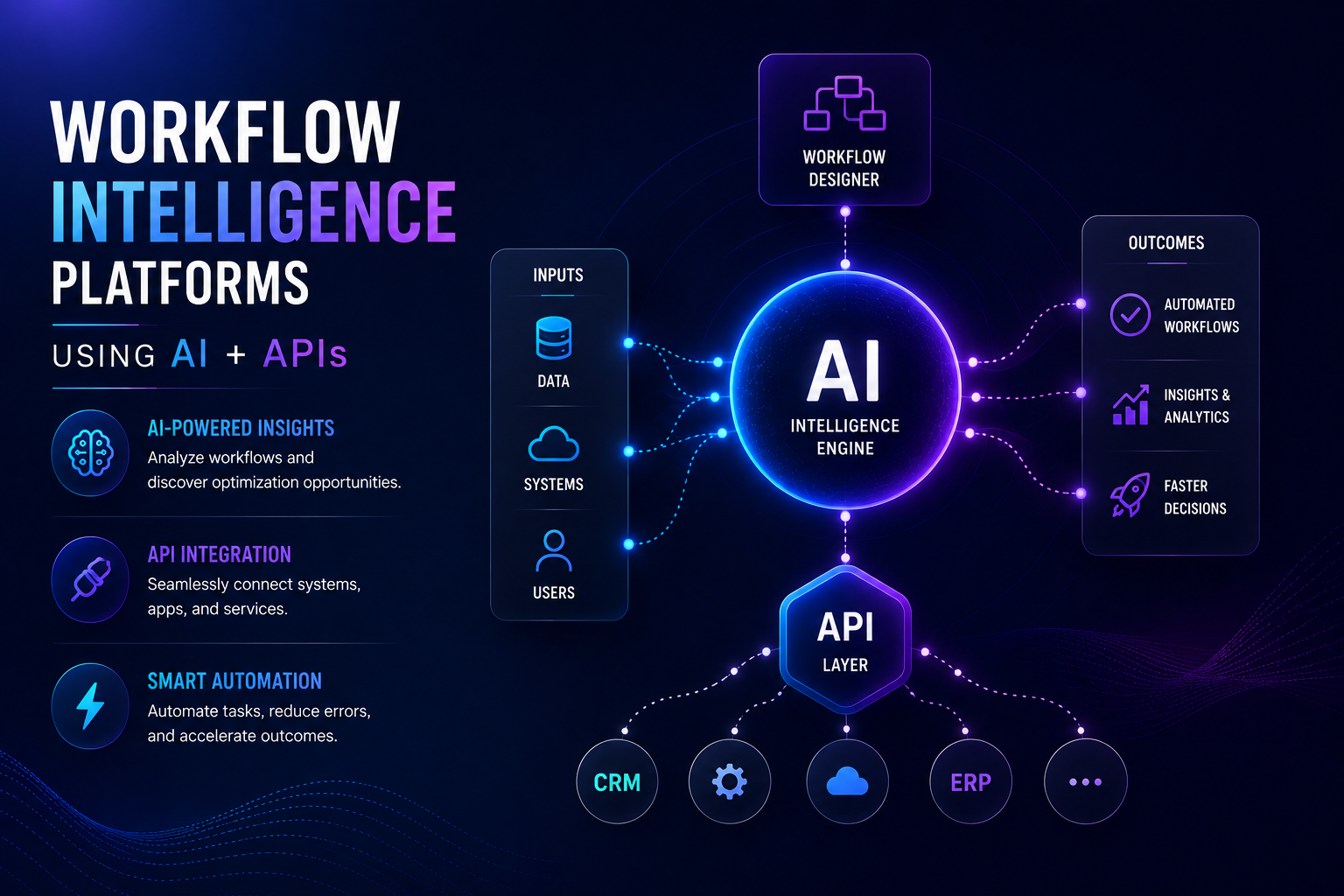
A Workflow Intelligence Platform is an advanced automation system that combines AI, APIs, analytics, and workflow orchestration to optimize business processes.
Unlike traditional workflow automation, workflow intelligence platforms can:
- Analyze business context
- Make data-driven decisions
- Trigger intelligent actions
- Coordinate multiple enterprise applications
- Learn from operational data
- Continuously improve workflows
The result is an adaptive automation ecosystem capable of responding to changing business conditions in real time.
Why Workflow Intelligence Matters in 2026
1. Increasing Process Complexity
Modern enterprises operate across:
- CRM platforms
- ERP systems
- HR applications
- Cloud services
- AI models
- Customer support tools
- Analytics platforms
Managing workflows across these systems manually is inefficient and difficult to scale.
2. Demand for Real-Time Decision-Making
Organizations require workflows that can:
- Respond instantly to business events
- Trigger automated actions
- Adapt to changing priorities
AI enables workflows to become dynamic instead of static.
3. Better Customer Experiences
Customers expect:
- Faster service
- Personalized interactions
- Immediate responses
Workflow intelligence helps organizations deliver consistent, high-quality experiences.
4. Greater Operational Efficiency
AI-driven workflows reduce:
- Manual approvals
- Repetitive tasks
- Processing delays
- Human errors
This allows teams to focus on strategic initiatives.
The Role of AI in Workflow Intelligence
Artificial Intelligence transforms workflows by introducing:
Intelligent Decision-Making
AI analyzes:
- Customer behavior
- Business rules
- Historical data
- Operational metrics
to determine the best next action.
Predictive Analytics
Machine learning models forecast:
- Customer demand
- Process bottlenecks
- Resource utilization
- Operational risks
This enables proactive business operations.
Natural Language Processing (NLP)
NLP allows workflows to process:
- Emails
- Documents
- Customer messages
- Support tickets
without manual classification.
AI Agents
AI agents can:
- Execute tasks
- Coordinate workflows
- Retrieve enterprise data
- Interact with APIs
- Recommend actions
They act as intelligent digital workers within enterprise workflows.
Why APIs Are Essential
APIs are the backbone of workflow intelligence platforms.
They connect:
- Enterprise applications
- SaaS platforms
- Databases
- Cloud services
- AI models
- External partners
API-first architecture ensures workflows remain modular, scalable, and easy to extend.
Core Components of a Workflow Intelligence Platform
API Integration Layer
Provides secure connectivity between:
- ERP systems
- CRM platforms
- HR software
- Financial systems
- AI services
This eliminates isolated workflows.
Workflow Orchestration Engine
Coordinates:
- Multi-step business processes
- Conditional logic
- Human approvals
- Automated actions
This ensures consistent execution across systems.
AI Decision Engine
The AI layer:
- Evaluates incoming data
- Predicts outcomes
- Selects optimal actions
- Improves workflow performance
This creates adaptive automation.
Event-Driven Architecture
Workflows respond instantly to events such as:
- New customer registrations
- Payment confirmations
- Inventory updates
- Support requests
- Security alerts
This enables real-time operations.
Analytics and Monitoring
Organizations monitor:
- Workflow completion rates
- Automation success
- API performance
- AI decision quality
- Business KPIs
Continuous monitoring supports ongoing optimization.
Governance and Security
Enterprise platforms include:
- Role-based access control
- Identity management
- API security
- Audit logging
- Compliance monitoring
This protects sensitive business processes.
How Workflow Intelligence Platforms Operate
A typical workflow follows these steps:
- A business event triggers the workflow.
- APIs collect data from connected systems.
- AI analyzes the information and determines the next best action.
- The orchestration engine coordinates tasks across applications.
- Automated actions are executed.
- Results are monitored and recorded.
- AI learns from outcomes to improve future workflow execution.
This creates a continuous cycle of automation and optimization.
Enterprise Use Cases
Customer Onboarding
Workflow intelligence can:
- Verify customer information
- Create CRM records
- Trigger compliance checks
- Generate contracts
- Send personalized communications
Result: Faster onboarding and improved customer satisfaction.
Financial Operations
Organizations automate:
- Invoice processing
- Expense approvals
- Budget workflows
- Compliance reporting
AI helps prioritize exceptions and reduce manual reviews.
Human Resources
Platforms streamline:
- Recruitment workflows
- Employee onboarding
- Leave approvals
- Performance evaluations
This improves HR efficiency and employee experience.
IT Service Management
Workflow intelligence supports:
- Incident routing
- Infrastructure monitoring
- Automated remediation
- User provisioning
Result: Faster resolution times and more reliable IT operations.
Sales and Marketing
AI-driven workflows help:
- Qualify leads
- Personalize campaigns
- Trigger follow-ups
- Recommend next-best actions
Sales teams can focus on building customer relationships.
Benefits of Workflow Intelligence Platforms
| Benefit | Business Impact |
|---|---|
| Intelligent Automation | Smarter workflows driven by AI |
| Faster Decision-Making | Real-time responses to business events |
| Improved Productivity | Reduced manual effort and repetitive tasks |
| Better Integration | Connects enterprise applications through APIs |
| Scalability | Supports business growth across departments |
| Continuous Optimization | AI improves workflow performance over time |
Workflow Intelligence vs Traditional Workflow Automation
| Traditional Automation | Workflow Intelligence |
|---|---|
| Fixed rules | AI-driven adaptive decisions |
| Static workflows | Dynamic and context-aware workflows |
| Manual optimization | Continuous AI learning |
| Limited integrations | API-first enterprise connectivity |
| Reactive processes | Predictive and proactive operations |
Workflow intelligence enables organizations to automate not just tasks, but also decision-making.
Challenges to Consider
Integration with Legacy Systems
Older systems may require APIs or middleware to participate in intelligent workflows.
AI Governance
Organizations should establish policies for:
- Decision transparency
- Human oversight
- Responsible AI usage
- Compliance
Data Quality
AI-driven workflows depend on accurate and consistent enterprise data.
Poor data quality can reduce automation effectiveness.
Security
Workflow platforms should include:
- Secure API authentication
- Encryption
- Role-based permissions
- Continuous monitoring
to protect business-critical operations.
Best Practices for Building Workflow Intelligence Platforms
Adopt an API-First Architecture
Design systems with reusable APIs to simplify integrations and future expansion.
Start with High-Value Processes
Automate workflows that have measurable business impact, such as customer onboarding, financial approvals, or IT operations.
Integrate AI Where It Delivers Clear Value
Use AI for tasks such as document classification, decision support, predictive analytics, and workflow optimization instead of applying it indiscriminately.
Build Modular Workflows
Create reusable workflow components that can be shared across departments and applications.
Measure and Improve Continuously
Track workflow performance, automation success rates, and business outcomes to identify opportunities for refinement.
How APISDOR Helps Build Workflow Intelligence Solutions
At APISDOR, we help enterprises:
- Design AI-powered workflow architectures
- Build API-first integration platforms
- Develop intelligent workflow orchestration systems
- Integrate AI agents with enterprise applications
- Enable real-time business automation
- Implement governance, monitoring, and security frameworks
Our solutions empower organizations to streamline operations, improve decision-making, and accelerate digital transformation through intelligent workflow automation.
FAQs: Workflow Intelligence Platforms
Q1. What is a workflow intelligence platform?
A: A workflow intelligence platform combines AI, APIs, workflow orchestration, and analytics to automate and optimize business processes through intelligent decision-making.
Q2. How is workflow intelligence different from traditional workflow automation?
A: Traditional automation follows predefined rules, while workflow intelligence uses AI to analyze context, make decisions, and continuously improve workflows.
Q3. Why are APIs important in workflow intelligence?
A: APIs connect enterprise systems, enabling workflows to access data, trigger actions, and integrate applications without creating tightly coupled dependencies.
Q4. Can workflow intelligence integrate with existing enterprise software?
A: Yes. API-first platforms can connect with ERP systems, CRM applications, HR software, cloud services, and many legacy systems using integration layers or middleware.
Q5. Which industries benefit most from workflow intelligence?
A: Financial services, healthcare, manufacturing, retail, logistics, telecommunications, SaaS, and professional services all benefit from AI-driven workflow intelligence by improving operational efficiency and customer experiences.
Conclusion
Workflow Intelligence Platforms are transforming enterprise automation by combining AI, APIs, and real-time orchestration into adaptive systems that go beyond repetitive task automation. They enable organizations to make faster decisions, optimize business processes continuously, and integrate complex technology ecosystems with greater efficiency.
As businesses continue to embrace AI-driven digital transformation, workflow intelligence will become a key differentiator for organizations seeking agility, productivity, and innovation.
With APISDOR as your technology partner, you can build intelligent workflow platforms that connect your enterprise systems, automate critical processes, and deliver scalable business outcomes for the future.


