
Enterprise Agentic AI Architecture Explained

Introduction
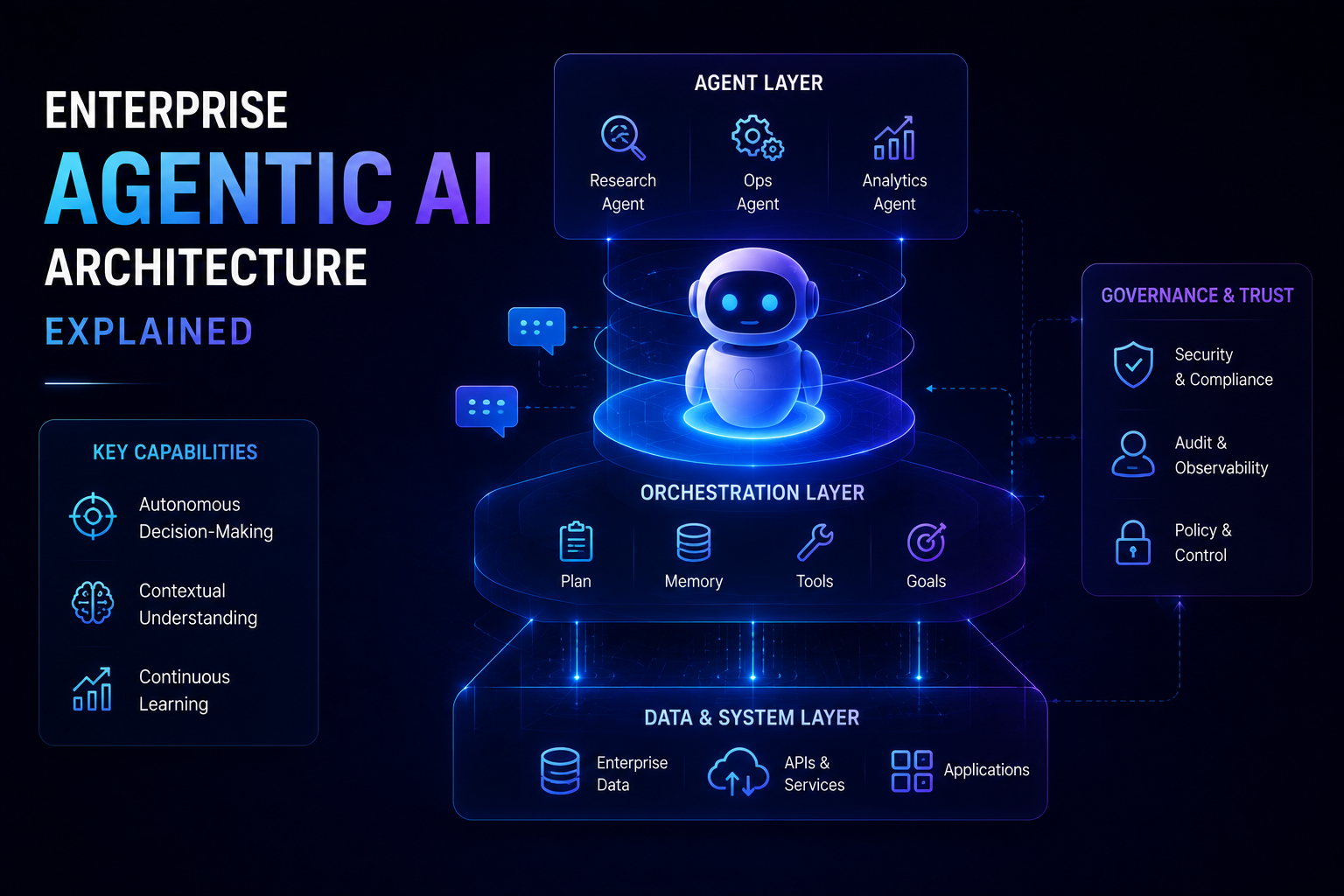
Artificial Intelligence is rapidly evolving from simple chatbots and predictive models to autonomous AI agents capable of reasoning, planning, and executing complex business tasks. As enterprises embrace AI to improve productivity and decision-making, the focus is shifting from isolated AI tools to Agentic AI architectures that can operate across multiple business systems.
Unlike traditional automation, Agentic AI enables software agents to understand goals, interact with enterprise applications, make contextual decisions, and continuously optimize workflows with minimal human intervention.
In 2026, Enterprise Agentic AI Architecture is becoming the foundation for next-generation digital enterprises, enabling organizations to automate knowledge work, streamline operations, and deliver intelligent customer experiences.
At APISDOR, we help organizations design secure, scalable, and enterprise-ready Agentic AI platforms that integrate seamlessly with existing business systems while ensuring governance, compliance, and long-term scalability.
What Is Enterprise Agentic AI?
Agentic AI refers to AI systems that can reason, plan, act, and learn to accomplish business objectives autonomously.
Unlike conventional AI models that simply answer questions or generate content, AI agents can:
- Understand business goals
- Break complex tasks into smaller steps
- Interact with enterprise applications
- Call APIs and external services
- Collaborate with other AI agents
- Learn from outcomes and improve performance
Instead of acting as assistants, AI agents function as intelligent digital workers capable of handling end-to-end business processes.
Why Agentic AI Is Transforming Enterprises
1. Moving Beyond Traditional Automation
Traditional automation depends on predefined rules.
Agentic AI can:
- Analyze situations
- Make informed decisions
- Adapt workflows dynamically
- Solve unexpected problems
This dramatically expands the scope of enterprise automation.
2. Managing Complex Business Operations
Modern organizations operate across:
- CRM platforms
- ERP systems
- HR applications
- Cloud services
- Customer support platforms
- Analytics systems
Agentic AI orchestrates these systems intelligently without requiring manual coordination.
3. Improving Decision-Making
AI agents analyze:
- Real-time business data
- Historical trends
- Customer behavior
- Operational metrics
to recommend or execute optimal actions.
4. Increasing Workforce Productivity
Rather than replacing employees, AI agents automate repetitive and time-consuming work, allowing teams to focus on innovation, strategic planning, and customer engagement.
Core Components of Enterprise Agentic AI Architecture
1. AI Agent Layer
The foundation consists of intelligent agents responsible for:
- Understanding goals
- Planning tasks
- Executing actions
- Collaborating with other agents
Different agents may specialize in areas such as finance, customer support, operations, or IT.
2. Large Language Models (LLMs)
LLMs provide:
- Natural language understanding
- Reasoning capabilities
- Contextual decision-making
- Conversational interfaces
They enable agents to communicate effectively with both users and enterprise systems.
3. Enterprise Knowledge Layer
AI agents rely on organizational knowledge, including:
- Internal documentation
- Policies
- Knowledge bases
- Databases
- Business rules
- Historical interactions
Connecting AI to trusted enterprise knowledge improves accuracy and decision quality.
4. Workflow Orchestration Engine
The orchestration layer manages:
- Multi-step workflows
- Task coordination
- Agent collaboration
- Business process automation
It ensures AI agents execute activities efficiently and in the correct sequence.
5. API and Integration Layer
Enterprise AI agents interact with:
- ERP systems
- CRM platforms
- HR software
- Payment gateways
- Cloud services
Data warehouses
APIs allow agents to retrieve information and perform business actions securely.
6. Memory and Context Management
Agentic AI requires both:
- Short-Term Memory
Maintains context during ongoing conversations and tasks. - Long-Term Memory
Stores organizational knowledge, historical decisions, and user preferences to improve future interactions.
7. Real-Time Data Layer
AI agents consume:
- Streaming data
- Business events
- IoT information
- Operational metrics
- Customer interactions
Real-time data enables immediate and informed decision-making.
8. Governance and Security Layer
Enterprise AI must include:
- Role-based access control
- Identity management
- Audit logging
- AI governance
- Compliance monitoring
- Human approval workflows for critical decisions
This ensures AI operates safely within organizational policies.
How Enterprise Agentic AI Works
A typical workflow includes:
- A user or business event initiates a request.
- The AI agent interprets the objective.
- It retrieves relevant enterprise knowledge.
- The agent creates an execution plan.
- APIs connect to enterprise applications.
- Business actions are performed automatically.
- Results are monitored and validated.
- The agent learns from outcomes to improve future performance.
This creates a continuous cycle of intelligent automation.
Enterprise Use Cases
Customer Service Automation
AI agents can:
- Resolve customer queries
- Access CRM records
- Update tickets
- Schedule follow-ups
Result: Faster support and improved customer satisfaction.
IT Operations (AIOps)
Agents monitor:
- Infrastructure health
- System logs
- Performance metrics
They can automatically resolve common issues before they impact users.
Human Resources
AI agents assist with:
- Employee onboarding
- Leave management
- Policy guidance
- Recruitment support
This improves HR efficiency and employee experience.
Finance and Accounting
Agentic AI automates:
- Invoice processing
- Expense approvals
- Financial reporting
- Fraud detection
Organizations reduce manual workloads while improving accuracy.
Sales and Marketing
AI agents can:
- Qualify leads
- Personalize campaigns
- Analyze customer behavior
- Recommend next-best actions
Sales teams gain more time to focus on relationship building.
Healthcare
Healthcare organizations use AI agents to:
- Assist clinicians with documentation
- Schedule appointments
- Analyze patient data
- Improve operational workflows
This supports better care delivery while reducing administrative tasks.
Benefits of Enterprise Agentic AI
| Benefit | Business Impact |
|---|---|
| Intelligent Automation | Automates complex decision-making |
| Higher Productivity | Reduces manual effort across departments |
| Faster Decisions | Real-time analysis and execution |
| Better Customer Experience | Personalized and responsive interactions |
| Scalability | Supports enterprise-wide operations |
| Continuous Learning | Improves performance over time |
Challenges of Agentic AI Adoption
AI Governance
Organizations need policies covering:
- Ethical AI usage
- Decision transparency
- Human oversight
Data Quality
AI agents rely on accurate, current, and trusted enterprise data.
Integration Complexity
Connecting AI with legacy applications and multiple cloud platforms requires strong API and integration strategies.
Security
Autonomous AI systems require:
- Secure API access
- Identity verification
- Encryption
- Continuous monitoring
Change Management
Successful adoption requires employee training, process redesign, and clear governance to build trust in AI-assisted workflows.
Best Practices for Building Agentic AI Platforms
Start With High-Impact Business Processes
Prioritize use cases such as customer support, IT operations, finance, or internal knowledge management where AI can deliver measurable value.
Build an API-First Architecture
Ensure AI agents can securely interact with enterprise systems through well-designed APIs.
Implement Human-in-the-Loop Controls
Critical decisions should include human review and approval when appropriate.
Invest in Enterprise Knowledge Management
Provide AI agents with access to reliable, well-governed organizational information.
Monitor and Continuously Improve
Track AI performance, user feedback, and operational outcomes to refine agent behavior over time.
How APISDOR Helps Build Enterprise Agentic AI Platforms
At APISDOR, we help enterprises:
- Design AI-native enterprise architectures
- Build intelligent AI agent platforms
- Integrate LLMs with enterprise applications
- Develop API-driven automation ecosystems
- Implement secure governance and compliance frameworks
- Deploy scalable cloud-native AI infrastructure
Our solutions enable organizations to transform traditional business processes into intelligent, autonomous workflows that deliver measurable business value.
FAQs: Enterprise Agentic AI Architecture
Q1. What is Agentic AI?
A: Agentic AI refers to autonomous AI systems that can reason, plan, make decisions, and execute tasks to achieve business objectives with minimal human intervention.
Q2. How is Agentic AI different from traditional AI?
A: Traditional AI typically performs a single task, such as generating text or making predictions. Agentic AI can coordinate multiple actions, interact with enterprise systems, and complete end-to-end workflows.
Q3. Can Agentic AI integrate with existing enterprise software?
A: Yes. Through APIs and workflow orchestration, AI agents can integrate with ERP systems, CRM platforms, HR software, cloud applications, and other enterprise tools.
Q4. Is Enterprise Agentic AI secure?
A: Yes. When implemented with role-based access control, API security, encryption, audit logging, and governance policies, Agentic AI can operate securely within enterprise environments.
Q5. Which industries benefit most from Agentic AI?
A: Financial services, healthcare, manufacturing, retail, logistics, SaaS, telecommunications, and professional services are among the industries seeing significant value from Agentic AI adoption.
Conclusion
Enterprise Agentic AI represents the next evolution of intelligent automation. By combining AI reasoning, enterprise knowledge, workflow orchestration, APIs, and real-time data, organizations can build autonomous systems that streamline operations, improve decision-making, and enhance customer experiences.
As businesses continue their digital transformation journeys, Agentic AI will become a key differentiator for organizations seeking greater agility, efficiency, and innovation.
With APISDOR as your technology partner, you can design and deploy secure, scalable, and enterprise-ready Agentic AI architectures that empower your workforce, automate complex business processes, and drive long-term competitive advantage.


