
Composable Automation Platforms for Modern Businesses
Introduction
Businesses today operate in an increasingly complex digital environment where applications, cloud services, APIs, AI systems, and data platforms must work together seamlessly. Traditional automation solutions often struggle to keep pace with evolving business requirements because they rely on rigid workflows and tightly coupled integrations.
To overcome these challenges, enterprises are embracing Composable Automation Platforms—a modern approach that enables organizations to build flexible, reusable, and scalable automation ecosystems using APIs, AI, low-code tools, and modular services.
In 2026, composable automation is helping organizations accelerate digital transformation, improve operational efficiency, and respond more quickly to changing business demands.
At APISDOR, we help enterprises design intelligent automation platforms that integrate applications, data, and AI into unified workflows capable of scaling with business growth.
What Is a Composable Automation Platform?
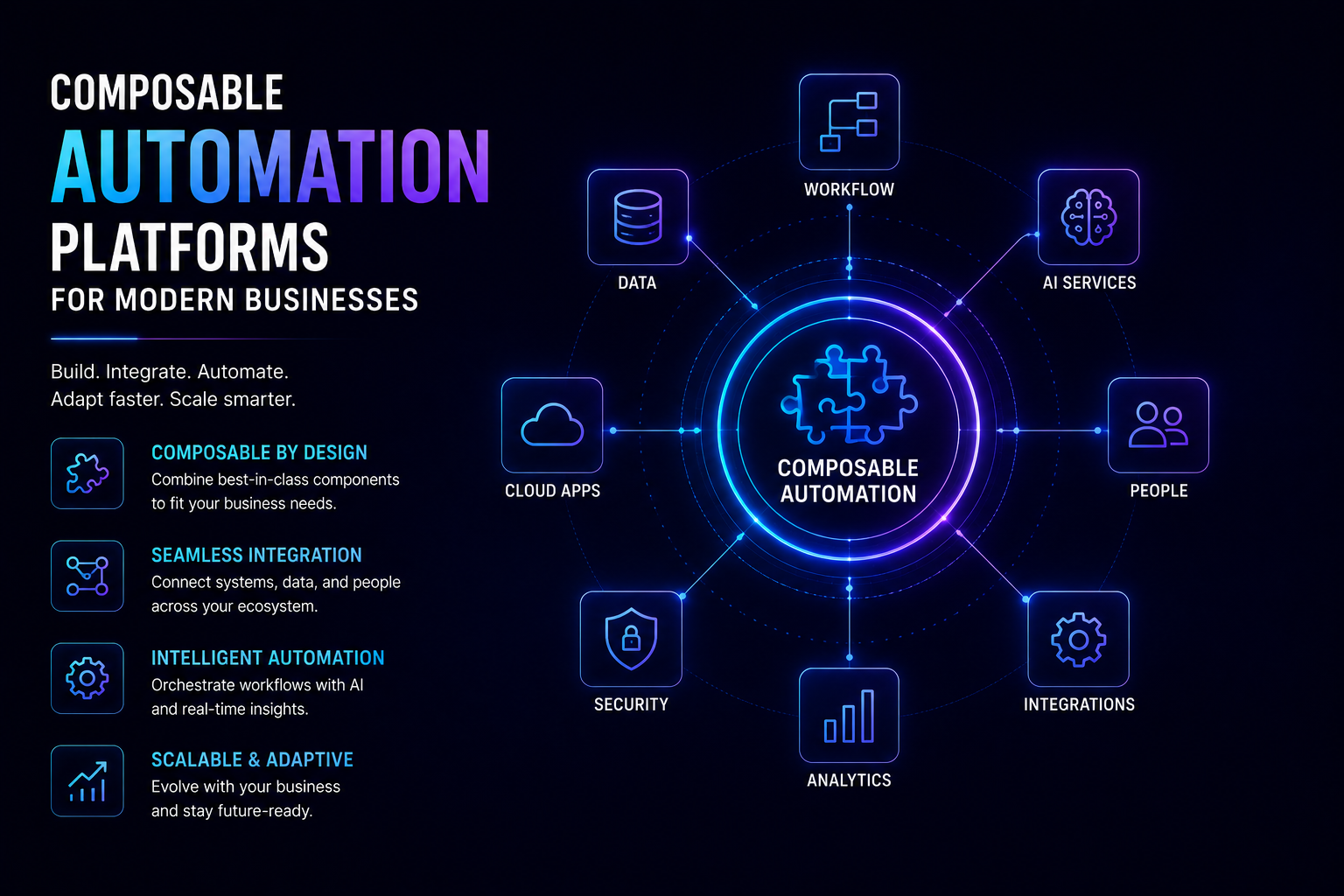
A composable automation platform is a modular automation framework where reusable components can be combined to create intelligent business workflows.
Instead of building large, fixed automation processes, organizations develop smaller, independent automation modules that can be reused across departments and applications.
These platforms typically include:
- API integrations
- Workflow orchestration
- AI-powered automation
- Event-driven architecture
- Low-code development tools
- Business rules engines
- Real-time analytics
The result is a flexible automation ecosystem that adapts as business needs evolve.
Why Modern Businesses Need Composable Automation
1. Increasing Business Complexity
Modern organizations use dozens—or even hundreds—of applications, including:
- CRM platforms
- ERP systems
- HR software
- Accounting tools
- Cloud applications
- Collaboration platforms
- AI services
Managing workflows across these systems manually is inefficient and prone to errors.
Composable automation connects these systems without creating tightly coupled dependencies.
2. Demand for Faster Innovation
Businesses need to:
- Launch new services quickly
- Adapt workflows rapidly
- Improve operational agility
Composable platforms allow organizations to build and modify automation without redesigning entire systems.
3. AI Is Changing Automation
Artificial Intelligence enables automation to become more intelligent by:
- Understanding natural language
- Making recommendations
- Predicting outcomes
- Triggering autonomous actions
Composable platforms make it easy to integrate AI capabilities into existing workflows.
4. Reducing Development Time
Reusable automation components eliminate duplicate work and enable teams to deliver solutions much faster.
Core Components of a Composable Automation Platform
API Integration Layer
APIs connect enterprise applications, cloud services, and third-party platforms.
This layer enables automation across:
- CRM systems
- ERP platforms
- Payment gateways
- Marketing platforms
- AI services
API-first design ensures scalability and flexibility.
Workflow Orchestration Engine
The orchestration engine coordinates:
- Multi-step business processes
- Cross-application workflows
- Conditional logic
- Event-based automation
This ensures tasks are executed in the correct sequence.
Event-Driven Architecture
Instead of relying on scheduled processes, modern platforms respond instantly to business events such as:
- New customer registrations
- Purchase orders
- Payment confirmations
- Inventory changes
- Support ticket creation
This enables real-time business operations.
AI and Decision Intelligence
AI enhances automation by:
- Analyzing business data
- Making recommendations
- Classifying documents
- Generating responses
- Predicting outcomes
This transforms traditional workflows into intelligent automation.
Low-Code Development
Low-code tools enable both developers and business users to build workflows using visual interfaces.
Benefits include:
- Faster development
- Reduced coding effort
- Improved collaboration
- Easier maintenance
Monitoring and Analytics
Composable automation platforms provide visibility into:
- Workflow performance
- Execution success rates
- API response times
- System health
- Business KPIs
Real-time dashboards help optimize operations continuously.
How Composable Automation Works
A typical automation workflow includes:
- A business event occurs (such as a new customer order).
- The platform detects the event.
- APIs retrieve relevant business data.
- AI analyzes the information if needed.
- The workflow engine determines the next actions.
- Tasks are executed across multiple systems.
- Results are monitored and recorded for future optimization.
This creates intelligent, end-to-end automation without manual intervention.
Enterprise Use Cases
Customer Onboarding
Automation can:
- Create CRM records
- Verify customer information
- Generate contracts
- Send welcome emails
- Schedule onboarding tasks
Result: Faster onboarding and improved customer experience.
Finance and Accounting
Composable workflows automate:
- Invoice approvals
- Expense processing
- Payment reconciliation
- Financial reporting
This reduces manual effort and improves accuracy.
HR Operations
Organizations automate:
- Employee onboarding
- Leave approvals
- Payroll updates
- Performance review reminders
Result: Increased HR efficiency and better employee experiences.
IT Operations
Automation platforms help:
- Provision user accounts
- Monitor infrastructure
- Resolve common incidents
- Manage software deployments
This reduces operational workload and improves system reliability.
Sales and Marketing
Composable workflows enable:
- Lead qualification
- Campaign automation
- Customer segmentation
- Personalized follow-ups
Sales teams can focus on building stronger customer relationships.
Benefits of Composable Automation Platforms
| Benefit | Business Impact |
|---|---|
| Flexibility | Easily adapt workflows to changing business needs |
| Scalability | Supports enterprise growth without major redesigns |
| Faster Development | Reusable components accelerate delivery |
| Improved Productivity | Reduces repetitive manual work |
| Better Integration | Connects cloud, on-premises, and AI systems |
| Intelligent Decision-Making | AI enhances workflow efficiency and outcomes |
Composable Automation vs Traditional Automation
| Traditional Automation | Composable Automation |
|---|---|
| Fixed workflows | Modular and reusable workflows |
| Tightly coupled integrations | API-first architecture |
| Manual updates | Dynamic and configurable |
| Limited scalability | Enterprise-scale flexibility |
| Rule-based automation | AI-powered intelligent automation |
Composable automation enables organizations to innovate continuously while reducing technical debt.
Challenges to Consider
Integration Complexity
Organizations often need to connect modern platforms with legacy systems. APIs and middleware can simplify this process.
Governance
As automation expands, businesses need clear policies for:
- Workflow ownership
- Access control
- Version management
- Compliance
Security
Automation platforms should include:
- Role-based access control
- API authentication
- Encryption
- Audit logging
to protect sensitive business processes.
Change Management
Successful adoption requires employee training and cross-functional collaboration to maximize the value of automation initiatives.
Best Practices for Building Composable Automation Platforms
Start with High-Impact Processes
Identify repetitive workflows that deliver measurable business value when automated.
Design API-First Architectures
Well-designed APIs make automation easier to build, extend, and maintain.
Use Reusable Components
Develop modular workflows that can be shared across teams and departments.
Integrate AI Where It Adds Value
Use AI for tasks such as document processing, predictive analytics, customer interactions, and decision support rather than automating everything indiscriminately.
Monitor and Optimize Continuously
Track workflow performance, business outcomes, and user feedback to improve automation over time.
How APISDOR Helps Build Composable Automation Solutions
At APISDOR, we help enterprises:
- Design composable automation architectures
- Build API-first integration platforms
- Implement AI-powered workflow automation
- Connect enterprise applications and cloud services
- Develop scalable low-code automation solutions
- Ensure governance, security, and compliance
Our approach enables businesses to create intelligent automation ecosystems that improve efficiency, reduce operational costs, and accelerate digital transformation.
FAQs: Composable Automation Platforms
Q1. What is a composable automation platform?
A: A composable automation platform is a modular framework that enables organizations to build reusable, scalable automation workflows by combining APIs, AI, and independent business services.
Q2. How is composable automation different from traditional automation?
A: Traditional automation relies on fixed, rule-based workflows. Composable automation uses reusable components, API-first integration, and AI to create flexible workflows that can evolve with business needs.
Q3. Can composable automation integrate with legacy systems?
A: Yes. APIs, middleware, and integration platforms allow organizations to connect legacy systems with modern cloud applications and automation workflows.
Q4. Does composable automation require coding?
A: Not always. Many platforms offer low-code or no-code interfaces that allow business users to create workflows, while developers can build advanced integrations when needed.
Q5. Which industries benefit most from composable automation?
A: Financial services, healthcare, retail, manufacturing, logistics, technology, telecommunications, and professional services all benefit from composable automation by improving efficiency and streamlining business processes.
Conclusion
Composable automation platforms are redefining how modern businesses design and execute workflows. By combining modular architecture, APIs, AI, and low-code development, organizations can build automation solutions that are flexible, scalable, and ready to adapt to future business demands.
Rather than relying on rigid automation systems, enterprises can continuously improve operations, integrate emerging technologies, and respond quickly to changing market conditions.
With APISDOR as your technology partner, you can build intelligent composable automation platforms that streamline operations, accelerate innovation, and support sustainable business growth in an increasingly digital world.


