
Self-Healing Enterprise Automation Systems
AI identifies unusual system behavior in real time.
Introduction
Modern enterprises rely on increasingly complex digital ecosystems that span cloud platforms, on-premises infrastructure, APIs, microservices, enterprise applications, AI models, and connected devices. While automation has significantly improved operational efficiency, traditional automation still depends heavily on human intervention whenever failures, unexpected events, or system anomalies occur.
This is where Self-Healing Enterprise Automation Systems are redefining business operations. By combining Artificial Intelligence (AI), machine learning, observability, automation, and predictive analytics, these systems can detect issues, diagnose root causes, and automatically resolve problems before they impact users or business processes.
In 2026, self-healing automation is emerging as a critical capability for enterprises seeking greater resilience, operational efficiency, and business continuity.
At APISDOR, we help organizations design intelligent automation platforms that not only automate business workflows but also continuously monitor, optimize, and repair themselves, enabling truly autonomous enterprise operations.
What Are Self-Healing Enterprise Automation Systems?
A self-healing automation system is an intelligent platform capable of automatically identifying operational issues, determining their causes, and executing corrective actions without requiring human intervention.
Unlike traditional automation that follows predefined rules, self-healing systems continuously learn from operational data and adapt their behavior to maintain optimal performance.
Typical capabilities include:
- Continuous system monitoring
- Real-time anomaly detection
- Root cause analysis
- Automated incident resolution
- Workflow optimization
- Predictive maintenance
- AI-driven decision-making
- Continuous learning
The objective is to minimize downtime while maximizing system reliability and operational efficiency.
Why Self-Healing Automation Is Becoming Essential
1. Increasing System Complexity
Today’s enterprise environments include:
- Cloud-native applications
- Microservices
- APIs
- Hybrid cloud infrastructure
- AI platforms
- IoT devices
- Multiple SaaS applications
Manual monitoring and troubleshooting cannot keep pace with this complexity.
2. Reducing Downtime
System outages can lead to:
- Revenue loss
- Customer dissatisfaction
- Productivity declines
- Compliance risks
Self-healing systems detect and resolve issues before they escalate into major incidents.
3. Supporting 24/7 Operations
Global organizations require continuous service availability.
Self-healing automation enables systems to operate around the clock with minimal human oversight.
4. Lowering Operational Costs
Automating routine incident detection and recovery reduces the workload on IT and operations teams, enabling teams to focus on strategic initiatives.
Core Components of a Self-Healing Automation Platform
AI-Powered Monitoring
The foundation of self-healing automation is continuous monitoring of:
- Applications
- Infrastructure
- APIs
- Databases
- Network traffic
- Business workflows
- AI services
Real-time visibility enables rapid issue detection.
Observability Layer
Observability collects and correlates:
- Metrics
- Logs
- Distributed traces
- Events
- Performance indicators
This provides comprehensive insights into system health.
Anomaly Detection Engine
Machine learning identifies unusual patterns such as:
- Performance degradation
- Unexpected traffic spikes
- Resource exhaustion
- Failed API calls
- Security anomalies
Early detection allows proactive intervention.
Root Cause Analysis
Instead of simply identifying symptoms, AI analyzes dependencies across systems to determine the underlying cause of an issue.
This reduces investigation time and improves recovery accuracy.
Automated Remediation Engine
Once the root cause is identified, predefined or AI-assisted workflows can automatically:
- Restart services
- Scale infrastructure
- Retry failed processes
- Roll back deployments
- Clear queues
- Switch to backup services
- Reconfigure applications
These actions restore normal operations without manual involvement.
Workflow Orchestration
Complex recovery processes often require coordination across multiple systems.
Workflow orchestration ensures remediation tasks are executed in the correct sequence while maintaining business continuity.
Predictive Intelligence
Predictive analytics examines historical trends to identify potential failures before they occur.
Examples include:
- Disk capacity forecasting
- Infrastructure resource planning
- Hardware failure prediction
- API performance degradation
- Database optimization
Governance and Security
Enterprise self-healing systems include:
- Role-based access control
- Policy enforcement
- Audit logging
- Compliance monitoring
- Human approval workflows for high-risk actions
This ensures automated actions remain secure and compliant.
How Self-Healing Enterprise Automation Works
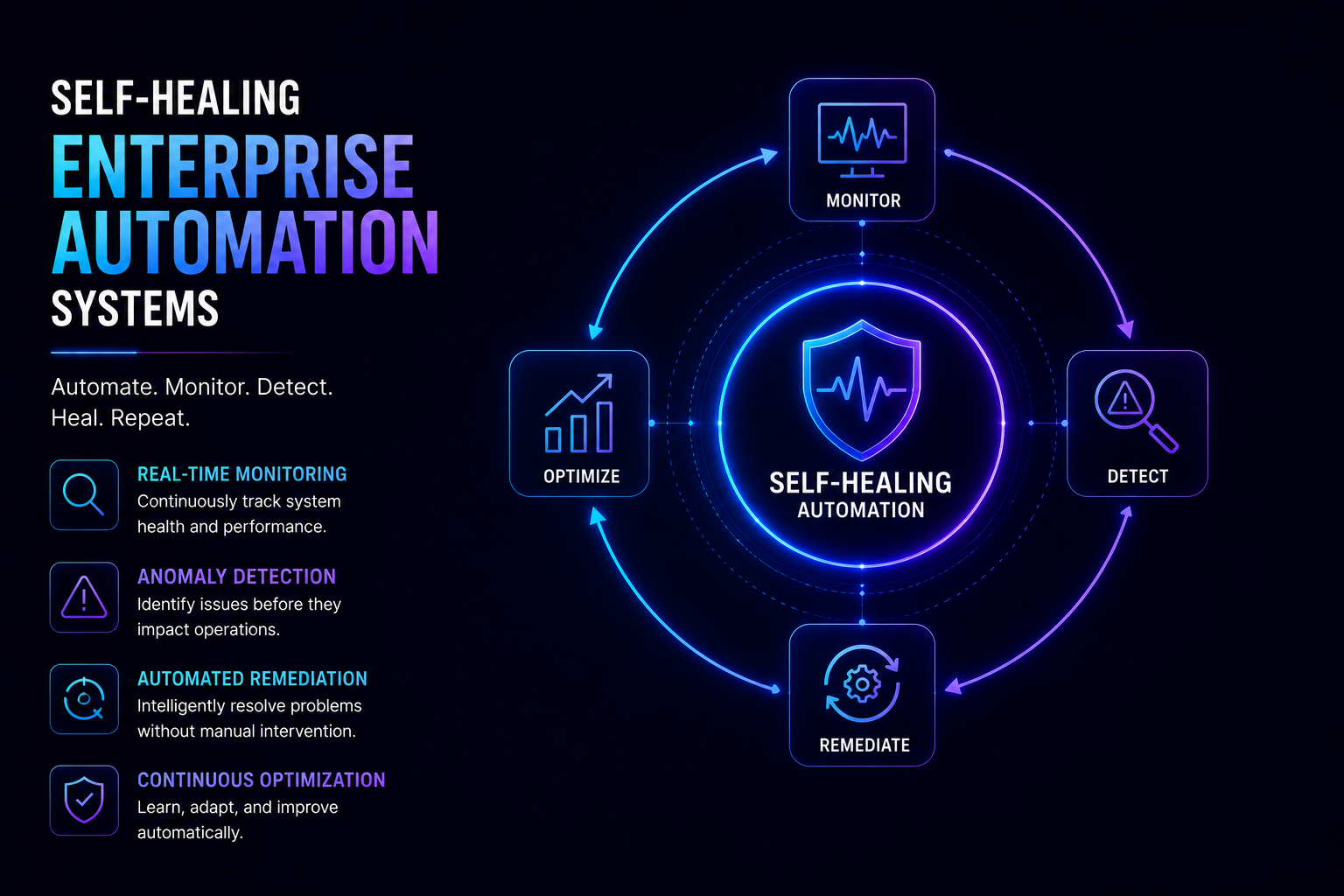
A typical workflow includes:
- Monitoring tools continuously collect operational data.
- AI identifies unusual system behavior in real time.
- The observability platform correlates logs, metrics, and traces.
- Root cause analysis identifies the source of the issue.
- The automation engine selects the appropriate remediation workflow.
- Corrective actions are executed automatically.
- System health is verified after recovery.
- AI records the outcome and improves future decision-making.
This creates a continuous cycle of detection, diagnosis, recovery, and optimization.
Enterprise Use Cases
IT Infrastructure Management
Self-healing systems automatically:
- Restart failed services
- Scale cloud resources
- Recover virtual machines
- Optimize server performance
Result: Improved system availability and reduced operational effort.
Cloud-Native Applications
Automation can:
- Detect unhealthy containers
- Replace failed Kubernetes pods
- Restart microservices
- Balance workloads
This improves application resilience in dynamic cloud environments.
Customer Support Platforms
If customer-facing applications experience failures, self-healing automation can:
- Restart APIs
- Restore integrations
- Redirect traffic
- Recover workflows
Result: Reduced service disruptions and improved customer satisfaction.
Financial Services
Automation platforms monitor:
- Transaction processing
- Payment gateways
- Fraud detection systems
- API performance
Automatic remediation helps maintain service continuity and regulatory compliance.
Manufacturing
Self-healing systems enable:
- Predictive equipment maintenance
- Automated production adjustments
- Supply chain optimization
- Machine health monitoring
This minimizes production downtime and increases operational efficiency.
Benefits of Self-Healing Enterprise Automation
| Benefit | Business Impact |
|---|---|
| Reduced Downtime | Faster issue detection and automated recovery |
| Increased Reliability | Higher availability of critical systems |
| Lower Operational Costs | Reduced manual intervention and incident response |
| Improved Productivity | IT teams focus on innovation instead of repetitive troubleshooting |
| Better Customer Experience | Fewer service interruptions and faster issue resolution |
| Continuous Optimization | AI learns from every incident to improve future performance |
Traditional Automation vs Self-Healing Automation
| Traditional Automation | Self-Healing Automation |
|---|---|
| Rule-based execution | AI-driven adaptive automation |
| Manual troubleshooting | Automated diagnosis and recovery |
| Reactive maintenance | Predictive and proactive operations |
| Fixed workflows | Intelligent, self-optimizing workflows |
| Limited operational visibility | End-to-end observability and analytics |
Challenges of Implementing Self-Healing Systems
Data Quality
Reliable monitoring depends on accurate logs, metrics, and telemetry. Poor-quality data can lead to incorrect remediation decisions.
Legacy System Integration
Older enterprise applications may require API modernization or middleware before they can participate in self-healing workflows.
Governance
Organizations should define clear policies for:
- Automated actions
- Escalation procedures
- Human approvals
- Compliance requirements
Security
Automated remediation engines must operate under strict access controls to prevent unauthorized or unintended changes.
Best Practices for Building Self-Healing Automation
Build Comprehensive Observability
Collect metrics, logs, traces, and events across infrastructure, applications, APIs, and AI services to create complete operational visibility.
Start with High-Frequency Incidents
Automate recovery for common issues such as service restarts, API retries, infrastructure scaling, and queue management before tackling more complex scenarios.
Integrate AI Responsibly
Use AI to assist with anomaly detection and root cause analysis, while maintaining human oversight for critical or high-impact actions.
Design Modular Automation Workflows
Create reusable remediation workflows that can be applied across multiple systems and business processes.
Continuously Measure and Improve
Track metrics such as Mean Time to Detect (MTTD), Mean Time to Repair (MTTR), incident recurrence, and automation success rates to refine self-healing capabilities over time.
How APISDOR Helps Build Self-Healing Enterprise Automation
At APISDOR, we help organizations:
- Design AI-powered automation architectures
- Build intelligent observability platforms
- Develop self-healing infrastructure and application workflows
- Implement API-driven remediation systems
- Integrate AI agents with enterprise operations
- Deploy cloud-native monitoring and automation solutions
- Ensure governance, security, and compliance across automated environments
Our solutions enable enterprises to reduce downtime, improve operational resilience, and accelerate digital transformation through intelligent autonomous operations.
FAQs: Self-Healing Enterprise Automation Systems
Q1. What is a self-healing automation system?
A: A self-healing automation system continuously monitors enterprise environments, detects issues, identifies root causes, and automatically performs corrective actions to maintain system availability and performance.
Q2. How does self-healing automation differ from traditional automation?
A: Traditional automation follows predefined rules and often requires human intervention when failures occur. Self-healing automation combines AI, observability, and automated remediation to diagnose and resolve issues autonomously.
Q3. Which technologies enable self-healing automation?
A: Key technologies include AI and machine learning, observability platforms, event-driven architectures, workflow orchestration, predictive analytics, APIs, cloud-native infrastructure, and automation engines.
Q4. Can self-healing automation be used with legacy enterprise systems?
A: Yes. Legacy systems can often be integrated using APIs, middleware, or integration platforms, allowing organizations to extend self-healing capabilities without replacing existing applications.
Q5. Which industries benefit the most from self-healing automation?
A: Financial services, healthcare, manufacturing, retail, telecommunications, logistics, SaaS, and public sector organizations all benefit by improving system reliability, reducing downtime, and enhancing operational efficiency.
Conclusion
As enterprise IT environments become more distributed, AI-driven, and mission-critical, organizations can no longer rely solely on manual monitoring and reactive incident management. Self-healing enterprise automation systems represent the next evolution of intelligent operations, combining observability, AI, predictive analytics, and workflow automation to proactively detect, diagnose, and resolve issues with minimal human intervention.
Businesses that invest in self-healing automation will improve resilience, reduce operational costs, strengthen customer experiences, and create a more agile foundation for future innovation.
With APISDOR as your technology partner, you can design and deploy enterprise-grade self-healing automation systems that transform your IT and business operations into intelligent, resilient, and autonomous ecosystems ready for the future.


