
Data Fabric Architecture for AI-Driven Organizations
Introduction
Artificial Intelligence (AI) is transforming how organizations operate, compete, and innovate. However, even the most advanced AI models are only as effective as the data they access. Many enterprises still struggle with fragmented data spread across cloud platforms, on-premises systems, SaaS applications, IoT devices, and legacy databases. These data silos limit the accuracy and effectiveness of AI initiatives.
To overcome this challenge, forward-thinking organizations are adopting Data Fabric Architecture—a modern approach that creates a unified, intelligent data layer across distributed environments. Instead of moving all data into a single repository, a data fabric connects and manages data wherever it resides, enabling secure, real-time access for analytics, automation, and AI applications.
In 2026, Data Fabric has become a foundational technology for organizations building scalable, AI-driven enterprises.
At APISDOR, we help businesses design and implement modern data fabric architectures that unlock trusted, connected, and AI-ready data across the enterprise.
What Is Data Fabric Architecture?
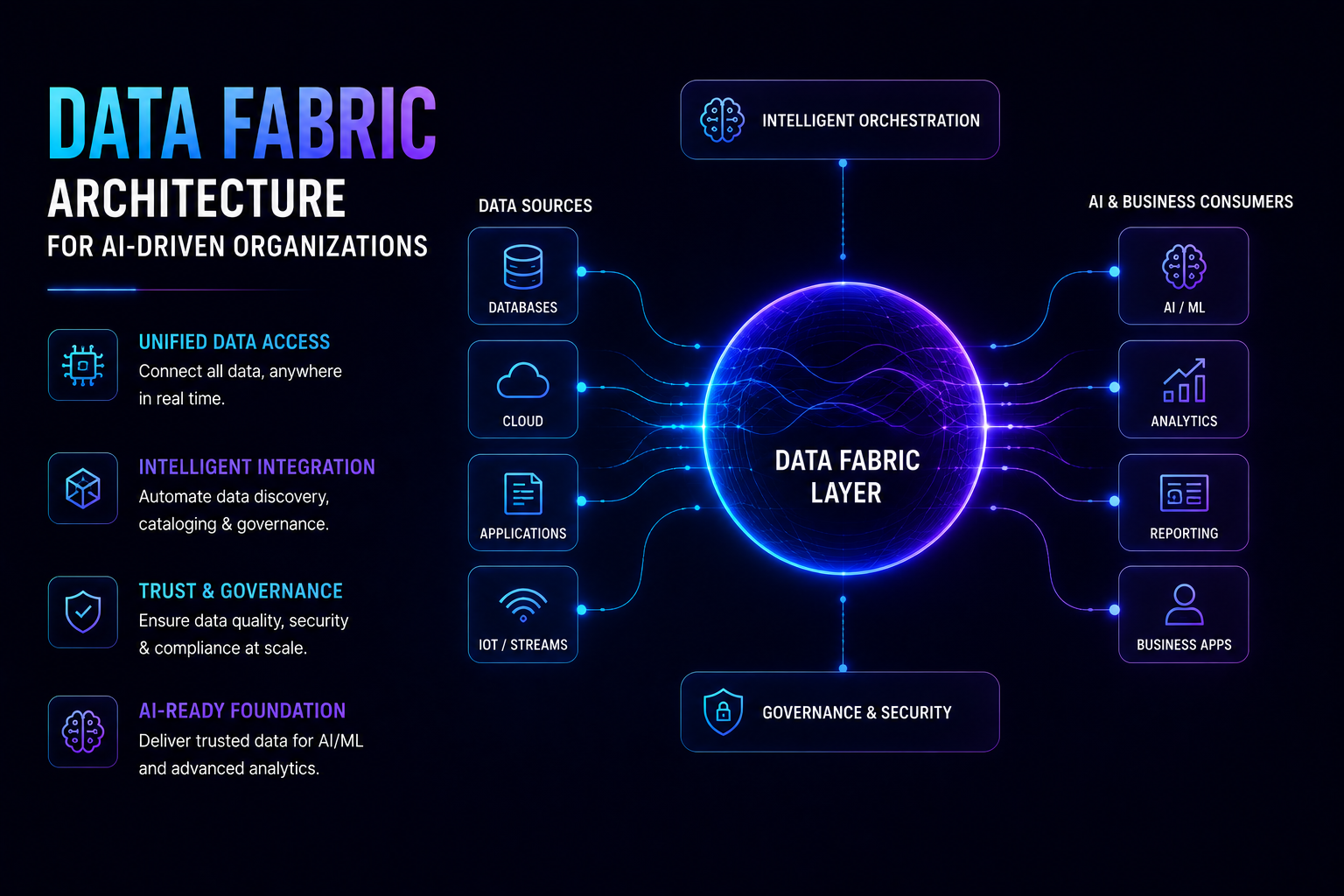
A Data Fabric is an architectural approach that integrates data across multiple environments using intelligent data management, automation, metadata, and APIs.
Rather than replacing existing databases or data warehouses, a data fabric creates a unified data layer that enables applications, analytics platforms, and AI systems to access trusted information regardless of where it is stored.
A modern data fabric typically connects:
- Cloud databases
- Data lakes
- Data warehouses
- Enterprise applications
- SaaS platforms
- IoT devices
- APIs
- Legacy systems
The goal is to provide secure, governed, and real-time access to enterprise data.
Why AI-Driven Organizations Need Data Fabric
1. Eliminating Data Silos
Data often exists across multiple departments and platforms, making it difficult to build a complete business view.
A data fabric connects these isolated systems into a unified ecosystem.
2. Accelerating AI Initiatives
AI models require:
- High-quality data
- Consistent data access
- Real-time information
- Trusted metadata
A data fabric provides the reliable foundation needed for AI and machine learning.
3. Supporting Real-Time Decision-Making
Modern businesses require immediate access to operational insights.
Data fabric architectures enable:
- Real-time analytics
- Event-driven applications
- AI-powered recommendations
- Operational intelligence
4. Simplifying Enterprise Integration
Instead of building countless point-to-point integrations, organizations use a centralized data layer that simplifies access across applications and business units.
Core Components of Data Fabric Architecture
1. Data Integration Layer
The integration layer connects data from:
- ERP systems
- CRM platforms
- Cloud applications
- Databases
- APIs
- Streaming platforms
This creates seamless data connectivity across the enterprise.
2. Metadata Management
Metadata describes:
- Data sources
- Relationships
- Ownership
- Quality
- Lineage
Intelligent metadata helps users discover and understand enterprise data more efficiently.
3. Data Governance
Governance ensures:
- Data quality
- Security
- Compliance
- Access control
- Policy enforcement
Strong governance is essential for trusted AI systems.
4. Data Virtualization
Instead of copying data into multiple locations, virtualization allows users and applications to access information from its original source.
Benefits include:
- Reduced duplication
- Lower storage costs
- Faster access to current data
5. API and Integration Services
APIs enable enterprise applications, AI models, and analytics platforms to access data consistently and securely.
An API-first approach improves scalability and interoperability.
6. AI and Automation Layer
AI enhances the data fabric by:
- Detecting data anomalies
- Classifying information
- Recommending data relationships
- Automating data quality improvements
- Optimizing data pipelines
Automation reduces manual data management tasks.
7. Security and Identity Management
Data fabric architectures include:
- Role-based access control
- Encryption
- Identity management
- Audit logging
- Zero Trust security principles
Sensitive information remains protected while enabling authorized access.
How Data Fabric Supports AI
AI applications require fast, reliable, and contextual access to enterprise data.
A data fabric enables:
Better Training Data
High-quality, governed data improves model accuracy.
Real-Time AI Inference
AI systems can access live operational data instead of relying only on historical datasets.
Enterprise Knowledge Integration
Data fabric connects AI models with:
- Internal documentation
- Business rules
- Product information
- Customer records
This improves AI-generated responses and recommendations.
AI Agent Enablement
AI agents can securely retrieve enterprise data through APIs and governance controls without requiring direct database access.
Enterprise Use Cases
Customer 360 Platforms
Organizations combine data from:
- CRM
- Sales
- Marketing
- Support
- Finance
to create a unified customer profile.
Intelligent Business Intelligence
Executives gain real-time dashboards powered by unified enterprise data rather than disconnected reports.
Predictive Maintenance
Manufacturers combine:
- IoT sensor data
- Equipment logs
- Maintenance records
to predict failures before they occur.
Healthcare Data Integration
Healthcare providers securely connect:
- Electronic Health Records (EHRs)
- Laboratory systems
- Medical devices
- Clinical applications
to improve patient care and operational efficiency.
Financial Services
Banks use data fabric to:
- Detect fraud
- Improve risk analysis
- Support regulatory reporting
- Deliver personalized financial services
Benefits of Data Fabric Architecture
| Benefit | Business Impact |
|---|---|
| Unified Data Access | Eliminates data silos across the organization |
| Faster AI Deployment | Provides trusted, AI-ready data |
| Improved Decision-Making | Real-time insights across business functions |
| Enhanced Data Governance | Better security, compliance, and quality |
| Operational Efficiency | Reduced integration complexity |
| Scalability | Supports hybrid and multi-cloud environments |
Data Fabric vs Traditional Data Architecture
| Traditional Architecture | Data Fabric Architecture |
|---|---|
| Data stored in isolated systems | Unified access across distributed data sources |
| Multiple point-to-point integrations | Centralized, intelligent data connectivity |
| Manual data management | AI-assisted automation and metadata management |
| Limited scalability | Cloud-native and hybrid-ready |
| Difficult AI integration | AI-ready architecture with governed access |
Challenges of Implementing Data Fabric
Legacy System Integration
Older enterprise systems may require APIs or middleware to participate in the data fabric.
Data Governance
Organizations need consistent policies for:
- Data ownership
- Quality standards
- Security
- Compliance
Metadata Management
Keeping metadata accurate and current is essential for effective data discovery and governance.
Organizational Change
Successful adoption requires collaboration among business, IT, data engineering, and AI teams.
Best Practices for Building a Data Fabric
Start with Business Priorities
Focus on high-value use cases such as customer analytics, AI initiatives, or operational reporting.
Adopt an API-First Strategy
APIs simplify secure and scalable access to enterprise data.
Automate Data Governance
Use AI and automation to improve metadata management, data quality, and policy enforcement.
Design for Hybrid and Multi-Cloud Environments
Ensure the architecture supports data across public clouds, private infrastructure, and on-premises systems.
Continuously Monitor Data Quality
Track completeness, accuracy, consistency, and freshness to ensure AI systems receive reliable information.
How APISDOR Helps Build AI-Ready Data Fabric Solutions
At APISDOR, we help enterprises:
- Design modern data fabric architectures
- Build unified enterprise data platforms
- Integrate cloud, on-premises, and SaaS systems
- Develop API-first data ecosystems
- Enable AI-ready data pipelines
- Implement governance, security, and compliance frameworks
- Optimize real-time analytics and business intelligence
Our solutions help organizations transform fragmented data into a strategic asset that powers AI, automation, and enterprise innovation.
FAQs: Data Fabric Architecture
Q1. What is a data fabric?
A: A data fabric is an architectural approach that connects and manages data across multiple systems, enabling unified, secure, and governed access without requiring all data to be stored in one place.
Q2. How does a data fabric support AI?
A: It provides AI models with trusted, real-time, and well-governed data from across the enterprise, improving model accuracy and decision-making.
Q3. What is the difference between a data fabric and a data lake?
A: A data lake is a centralized repository for storing large volumes of raw data. A data fabric is a broader architecture that connects multiple data sources—including data lakes, warehouses, databases, and SaaS applications—through a unified management layer.
Q4. Can a data fabric work with existing enterprise systems?
A: Yes. Data fabric architectures are designed to integrate with existing databases, cloud platforms, ERP systems, CRM applications, and legacy environments using APIs, connectors, and integration services.
Q5. Which industries benefit most from data fabric architecture?
A: Financial services, healthcare, manufacturing, retail, logistics, telecommunications, government, and SaaS organizations all benefit from improved data accessibility, governance, and AI readiness.
Conclusion
As enterprises become increasingly AI-driven, the ability to access trusted, connected, and real-time data is becoming a competitive advantage. Data Fabric Architecture provides the foundation for breaking down data silos, simplifying integration, strengthening governance, and enabling intelligent decision-making across the organization.
Rather than replacing existing systems, a data fabric connects them into a unified ecosystem that supports AI, analytics, automation, and digital transformation initiatives.
With APISDOR as your technology partner, you can build scalable, secure, and AI-ready data fabric solutions that transform enterprise data into actionable intelligence, accelerate innovation, and position your organization for long-term success in the digital economy.


