
AI Factories: Building Enterprise AI Infrastructure at Scale
Introduction
Artificial Intelligence has evolved from experimental pilots into a core driver of enterprise innovation. Organizations are deploying AI across customer service, software development, finance, cybersecurity, healthcare, supply chain operations, and business intelligence. As AI adoption accelerates, businesses need more than powerful models—they need a scalable infrastructure capable of developing, deploying, managing, and governing AI across the enterprise.
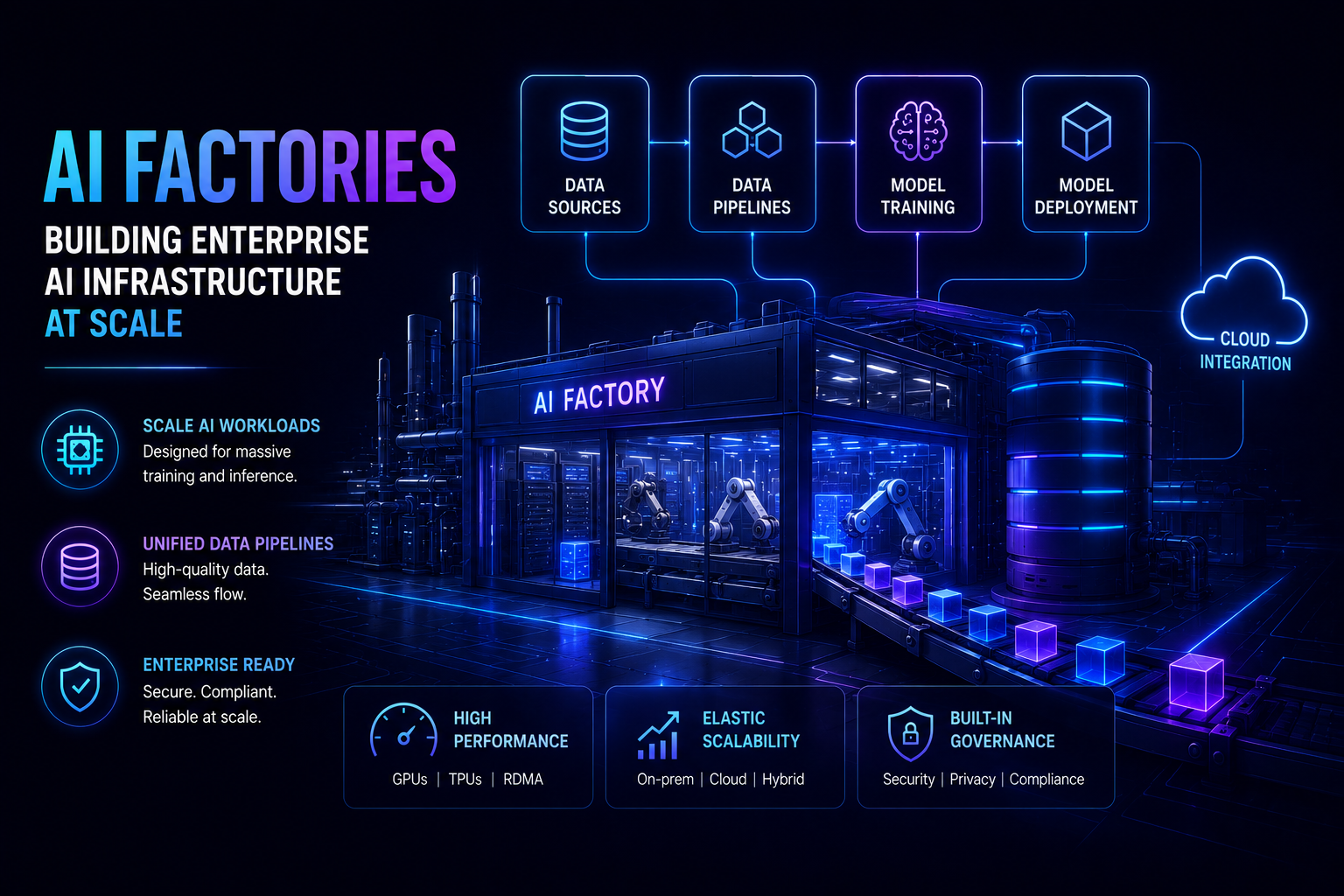
This is where AI Factories are transforming enterprise technology. Similar to how manufacturing factories standardized production, AI factories standardize the lifecycle of building, deploying, and operating AI solutions. They combine computing infrastructure, data platforms, machine learning operations (MLOps), automation, APIs, and governance into a unified ecosystem that continuously produces and improves AI applications.
In 2026, AI factories are becoming the backbone of enterprise AI strategies, enabling organizations to scale innovation while maintaining security, compliance, and operational efficiency.
At APISDOR, we help enterprises design AI-ready infrastructure that supports large-scale AI adoption and delivers measurable business outcomes.
What is an AI Factory?
An AI Factory is an integrated platform that enables organizations to build, train, deploy, monitor, and continuously improve AI models at scale.
Unlike isolated AI projects, an AI factory creates a repeatable framework where teams can efficiently develop AI-powered solutions using shared infrastructure and standardized processes.
An enterprise AI factory typically includes:
- High-performance computing infrastructure
- Data engineering and storage platforms
- AI model development environments
- MLOps pipelines
- API management
- Workflow automation
- Monitoring and observability
- Security and governance frameworks
The objective is to make AI development as efficient and scalable as software development.
Why AI Factories Matter in 2026
1. Enterprise AI Adoption Is Accelerating
Organizations are implementing AI across:
- Customer support
- Predictive analytics
- Intelligent automation
- Software engineering
- Financial operations
- Cybersecurity
- Healthcare systems
Managing these initiatives individually leads to duplicated infrastructure, inconsistent governance, and slower innovation.
AI factories centralize AI development and operations.
2. Scaling AI Beyond Pilot Projects
Many organizations successfully build AI prototypes but struggle to deploy them across production environments.
AI factories provide standardized deployment pipelines that transform experiments into enterprise-ready solutions.
3. Supporting Large Language Models and AI Agents
Modern enterprises increasingly deploy:
- Large Language Models (LLMs)
- Retrieval-Augmented Generation (RAG)
- AI agents
- Computer vision models
- Predictive analytics
These workloads require specialized infrastructure capable of handling large datasets, GPUs, and continuous model optimization.
4. Improving Operational Efficiency
A centralized AI infrastructure reduces:
- Development duplication
- Infrastructure costs
- Model deployment time
- Operational complexity
Teams can focus on creating business value rather than managing fragmented AI environments.
Core Components of an Enterprise AI Factory
1. High-Performance Compute Infrastructure
AI workloads require significant computing resources.
Infrastructure may include:
- GPU clusters
- CPU compute nodes
- High-speed networking
- Distributed computing platforms
Scalable computing enables rapid model training and inference.
2. Unified Data Platform
AI depends on high-quality data.
An enterprise AI factory includes:
- Data lakes
- Data warehouses
- Streaming pipelines
- Data catalogs
- Feature stores
A unified data platform ensures AI models have consistent and reliable data.
3. AI Model Development Environment
Data scientists and AI engineers need collaborative environments for:
- Model experimentation
- Training
- Evaluation
- Fine-tuning
- Version control
Standardized development environments improve collaboration and reproducibility.
4. MLOps Pipeline
Machine Learning Operations (MLOps) automate the AI lifecycle, including:
- Model training
- Validation
- Deployment
- Monitoring
- Continuous improvement
MLOps helps organizations deploy AI solutions faster while maintaining quality.
5. AI Agent Framework
Modern AI factories increasingly include infrastructure for:
- Autonomous AI agents
- Multi-agent collaboration
- Workflow orchestration
- Tool integration
- Enterprise knowledge retrieval
These frameworks enable intelligent automation across business functions.
6. API and Integration Layer
Enterprise AI must interact with:
- ERP systems
- CRM platforms
- Cloud applications
- Databases
- Business intelligence tools
- External services
API-first architecture enables seamless integration across the enterprise.
7. Monitoring and Observability
Organizations monitor:
- Model accuracy
- Response latency
- GPU utilization
- Infrastructure health
- API performance
- AI agent behavior
Continuous monitoring ensures reliable AI operations.
8. Security and Governance
Enterprise AI requires:
- Identity and access management
- Encryption
- Audit logging
- Responsible AI policies
- Compliance monitoring
- Model governance
Strong governance builds trust and reduces operational risk.
AI Factory Architecture
A typical enterprise AI factory consists of:
- Data sources and enterprise applications
- Data ingestion pipelines
- Unified data platform
- GPU and cloud computing infrastructure
- AI model development environment
- MLOps automation
- AI agents and workflow orchestration
- API gateway and integration services
- Monitoring dashboards
- Security and governance controls
This architecture enables continuous AI innovation across the organization.
Enterprise Use Cases
Intelligent Customer Support
AI factories power:
- AI chatbots
- Voice assistants
- Knowledge retrieval systems
- Customer service automation
Result: Faster support and improved customer satisfaction.
Software Development
AI infrastructure enables:
- Code generation
- Automated testing
- Documentation
- Developer assistants
Engineering teams become more productive.
Financial Services
Organizations use AI factories for:
- Fraud detection
- Risk analysis
- Financial forecasting
- Regulatory compliance
This improves operational efficiency while reducing risk.
Manufacturing
AI enables:
- Predictive maintenance
- Quality inspection
- Production optimization
- Supply chain forecasting
Operations become more efficient and reliable.
Healthcare
Healthcare organizations leverage AI factories for:
Medical image analysis
Clinical decision support
Patient risk prediction
Administrative automation
This enhances both patient care and operational performance.
Benefits of Enterprise AI Factories
| Benefit | Business Impact |
|---|---|
| Faster AI Deployment | Reduced time from prototype to production |
| Scalability | Supports enterprise-wide AI adoption |
| Cost Efficiency | Shared infrastructure reduces duplication |
| Higher Productivity | Standardized AI development workflows |
| Better Governance | Improved compliance and model management |
| Continuous Innovation | Accelerated delivery of AI-powered solutions |
Challenges of Building AI Factories
Infrastructure Investment
Building AI-ready infrastructure requires planning for compute, storage, networking, and long-term scalability.
Data Quality
Poor-quality data directly affects AI performance. Strong data governance and preparation are essential.
Talent Requirements
Successful AI factories rely on collaboration among:
- AI engineers
- Data scientists
- Platform engineers
- DevOps teams
- Security specialists
Governance
Organizations must establish policies for:
- Model validation
- Ethical AI
- Data privacy
- Risk management
- Human oversight
Best Practices for Building Enterprise AI Factories
Start with High-Value Business Use Cases
Focus initial investments on areas where AI can deliver measurable improvements, such as customer service, software development, operations, or analytics.
Build an API-First AI Platform
APIs enable AI models and agents to integrate seamlessly with enterprise systems and workflows.
Invest in MLOps Early
Automated pipelines improve deployment speed, model quality, and lifecycle management.
Implement Responsible AI Governance
Define policies for transparency, security, explainability, and regulatory compliance from the beginning.
Design for Continuous Improvement
Treat AI as an evolving capability by continuously monitoring performance, retraining models, and incorporating user feedback.
How APISDOR Helps Build Enterprise AI Factories
At APISDOR, we help enterprises:
- Design enterprise AI architectures
- Build scalable AI infrastructure
- Develop MLOps pipelines
- Deploy AI agents and intelligent automation
- Integrate AI with enterprise applications through APIs
- Implement governance, monitoring, and security frameworks
- Optimize AI platforms for long-term scalability
Our solutions help organizations transform isolated AI initiatives into enterprise-wide capabilities that deliver measurable business value.
FAQs: AI Factories
Q1. What is an AI Factory?
A: An AI Factory is a centralized platform that standardizes the development, deployment, management, and governance of AI solutions across an organization.
Q2. How is an AI Factory different from an AI project?
A: An AI project focuses on solving a specific problem, while an AI Factory provides the infrastructure, processes, and tools needed to build and manage many AI solutions at scale.
Q3. Do AI Factories only support Generative AI?
A: No. They support a wide range of AI workloads, including predictive analytics, computer vision, recommendation engines, AI agents, and generative AI applications.
Q4. Why is MLOps important in an AI Factory?
A: MLOps automates model training, testing, deployment, monitoring, and updates, making AI systems more reliable and easier to manage.
Q5. Which industries benefit most from AI Factories?
A: Financial services, healthcare, manufacturing, retail, telecommunications, logistics, technology, and public sector organizations all benefit from enterprise AI infrastructure.
Conclusion
AI Factories represent the next evolution of enterprise AI adoption. By combining scalable computing, unified data platforms, MLOps, AI agents, APIs, and governance into a single ecosystem, organizations can accelerate innovation while maintaining security and operational excellence.
As AI becomes a core component of business strategy, enterprises that invest in robust AI infrastructure will be better positioned to deploy intelligent applications, automate complex workflows, and gain a sustainable competitive advantage.
With APISDOR as your technology partner, you can build enterprise AI factories that empower teams, streamline AI operations, and transform artificial intelligence into a scalable engine for long-term business growth.


