
AI-Powered Enterprise Automation Strategies
Introduction
Enterprise automation has entered a new phase. While traditional automation focused on repetitive, rule-based tasks, AI-powered automation is transforming how organizations operate, decide, and scale.
In 2026, enterprises are no longer automating tasks—they are automating decisions, workflows, and outcomes. AI enables systems to understand context, learn from data, and act autonomously across complex business environments.
At APISDOR, we help enterprises design and implement AI-powered automation strategies that move beyond efficiency and deliver measurable business value.
What Is AI-Powered Enterprise Automation?
AI-powered enterprise automation combines:
- Artificial Intelligence (ML, LLMs, AI agents)
- Workflow orchestration
- API and system integration
- Human-in-the-loop governance
Unlike traditional automation, AI-driven automation can:
- Handle unstructured data
- Adapt to change
- Make contextual decisions
- Continuously improve over time
It represents a shift from static automation to intelligent, self-optimizing operations.
Why Enterprises Are Adopting AI-Powered Automation
1. Increasing Business Complexity
Enterprises operate across:
- Hybrid and multi-cloud environments
- Dozens of SaaS platforms
- Distributed teams and data sources
AI-powered automation helps manage this complexity without increasing manual effort.
2. Need for Speed and Agility
Markets change faster than traditional automation can adapt.
AI enables:
- Real-time decision-making
- Faster process execution
- Rapid response to anomalies and opportunities
Agility becomes a competitive advantage.
3. Talent and Productivity Challenges
AI automation:
- Reduces dependency on manual work
- Augments human teams
- Allows skilled employees to focus on higher-value tasks
This improves productivity without increasing headcount.
Core AI-Powered Automation Strategies for Enterprises
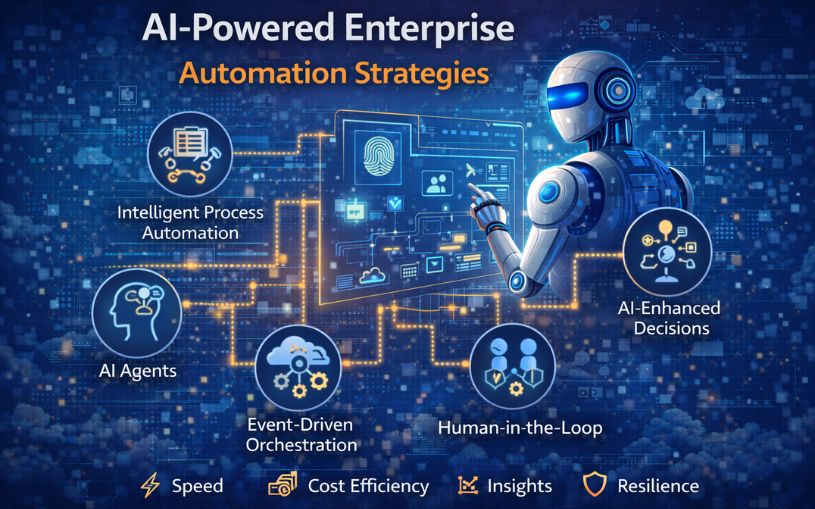
1. Intelligent Process Automation (IPA)
IPA combines RPA with AI to automate end-to-end processes.
Examples:
- Invoice processing with AI-based validation
- Claims handling with anomaly detection
- Order management with predictive decisioning
Result: Faster cycles, fewer errors, better outcomes.
2. AI Agents for Autonomous Operations
AI agents can:
- Monitor systems and data streams
- Make decisions based on context
- Trigger actions across platforms
- Collaborate with humans and other agents
Use cases include IT operations, finance monitoring, customer support, and DevOps.
3. Event-Driven Workflow Orchestration
AI-powered automation thrives in event-driven environments.
Key capabilities:
- Real-time triggers
- Intelligent routing
- Automated escalation
- Continuous optimization
This enables enterprises to move from reactive to proactive operations.
4. AI-Enhanced Decision Automation
AI supports decision-making by:
- Analyzing large datasets
- Predicting outcomes
- Recommending next-best actions
- Explaining decisions where required
This is critical for finance, supply chain, risk, and compliance functions.
5. Human-in-the-Loop Automation
Not every decision should be fully automated.
AI-powered strategies include:
- Approval checkpoints
- Confidence-based escalation
- Explainable AI outputs
This ensures trust, compliance, and accountability.
Enterprise Benefits of AI-Powered Automation
| Business Area | Impact |
|---|---|
| Operations | Faster, autonomous workflows |
| Cost Efficiency | Reduced manual effort and rework |
| Decision-Making | Data-driven, real-time insights |
| Scalability | Automation that grows with the business |
| Resilience | Predictive issue detection and response |
AI automation transforms automation from a cost saver into a growth enabler.
Governance, Security, and Responsible AI
Successful AI-powered automation requires strong governance:
- Data privacy and access control
- Model transparency and explainability
- Bias detection and mitigation
- Auditability and compliance
- Continuous monitoring
At APISDOR, responsible AI is embedded into every automation strategy we design.
How APISDOR Enables AI-Powered Enterprise Automation
APISDOR helps enterprises:
- Identify high-impact automation opportunities
- Design AI-first automation architectures
- Orchestrate workflows across systems and teams
- Integrate AI agents, APIs, and platforms
- Ensure security, governance, and scalability
Our focus is on business outcomes—not just automation volume.
Common Challenges (and How to Overcome Them)
- Fragmented systems → Unified orchestration platforms
- Poor data quality → AI-driven data management
- Lack of trust in AI → Human-in-the-loop design
- Scalability concerns → Cloud-native automation architectures
With the right strategy, these challenges become manageable.
Best Practices for AI-Powered Automation Adoption
- Start with measurable, high-value use cases
- Combine AI with existing automation tools
- Build strong data and governance foundations
- Involve businesses and IT teams together
- Continuously monitor and optimize
AI-powered automation is a journey, not a one-time project.
FAQs: AI-Powered Enterprise Automation
Q1. How is AI-powered automation different from RPA?
A: AI-powered automation can handle unstructured data, make decisions, and adapt—RPA cannot.
Q2. Is AI automation secure for enterprises?
A: Yes, when implemented with proper governance, access controls, and monitoring.
Q3. Does AI automation replace employees?
A: No. It augments human capabilities and frees teams for higher-value work.
Q4. How long does it take to see ROI?
A: Many enterprises see benefits within weeks to months, depending on use cases.
Q5. Where should enterprises start?
A: Start with processes that are repetitive, data-heavy, and decision-driven.
Conclusion
AI-powered enterprise automation is redefining how organizations operate in 2026. It is no longer about automating tasks—it is about enabling intelligent, autonomous, and resilient businesses.
Enterprises that adopt AI-powered automation strategically will move faster, operate smarter, and scale with confidence.
With APISDOR as your partner, AI-powered automation becomes a business advantage, not a technical challenge.


