
Composable APIs: The Secret Behind Scalable Digital Products
Introduction
Modern digital products must evolve faster than ever. Businesses are expected to launch new features quickly, scale globally, integrate with multiple platforms, and deliver seamless user experiences across devices and channels.
Traditional monolithic architectures often struggle to support these demands. In response, enterprises are adopting composable APIs—a modular approach that enables digital products to scale, adapt, and innovate rapidly.
In 2026, composable APIs are becoming the foundation of scalable digital platforms, powering everything from SaaS applications and eCommerce systems to AI-driven enterprise ecosystems.
At APISDOR, we help organizations build API-first, composable architectures that enable agility, scalability, and long-term digital growth.
What Are Composable APIs?
Composable APIs are modular, reusable APIs designed to expose specific business capabilities independently.
Instead of building tightly coupled systems, enterprises create:
- Independent API services
- Reusable business functions
- Flexible integration layers
- Scalable digital components
These APIs can be combined (“composed”) to quickly create new applications, workflows, and user experiences.
Why Composable APIs Matter in 2026
1. Faster Product Innovation
Composable APIs allow teams to:
- Reuse existing services
- Launch new features quickly
- Reduce duplicate development efforts
This accelerates product delivery and experimentation.
2. Scalability for Modern Digital Platforms
Scalable digital products require:
- Independent service scaling
- Real-time integrations
- Distributed architectures
Composable APIs support cloud-native scalability and high-performance operations.
3. Flexibility Across Channels
Modern applications operate across:
- Mobile apps
- Web platforms
- IoT devices
- AI systems
- Partner ecosystems
Composable APIs enable consistent functionality across all channels.
4. Easier Integration with Emerging Technologies
Composable APIs simplify integration with:
- AI and machine learning platforms
- Automation systems
- Cloud services
- Third-party ecosystems
This enables faster digital transformation.
How Composable APIs Work
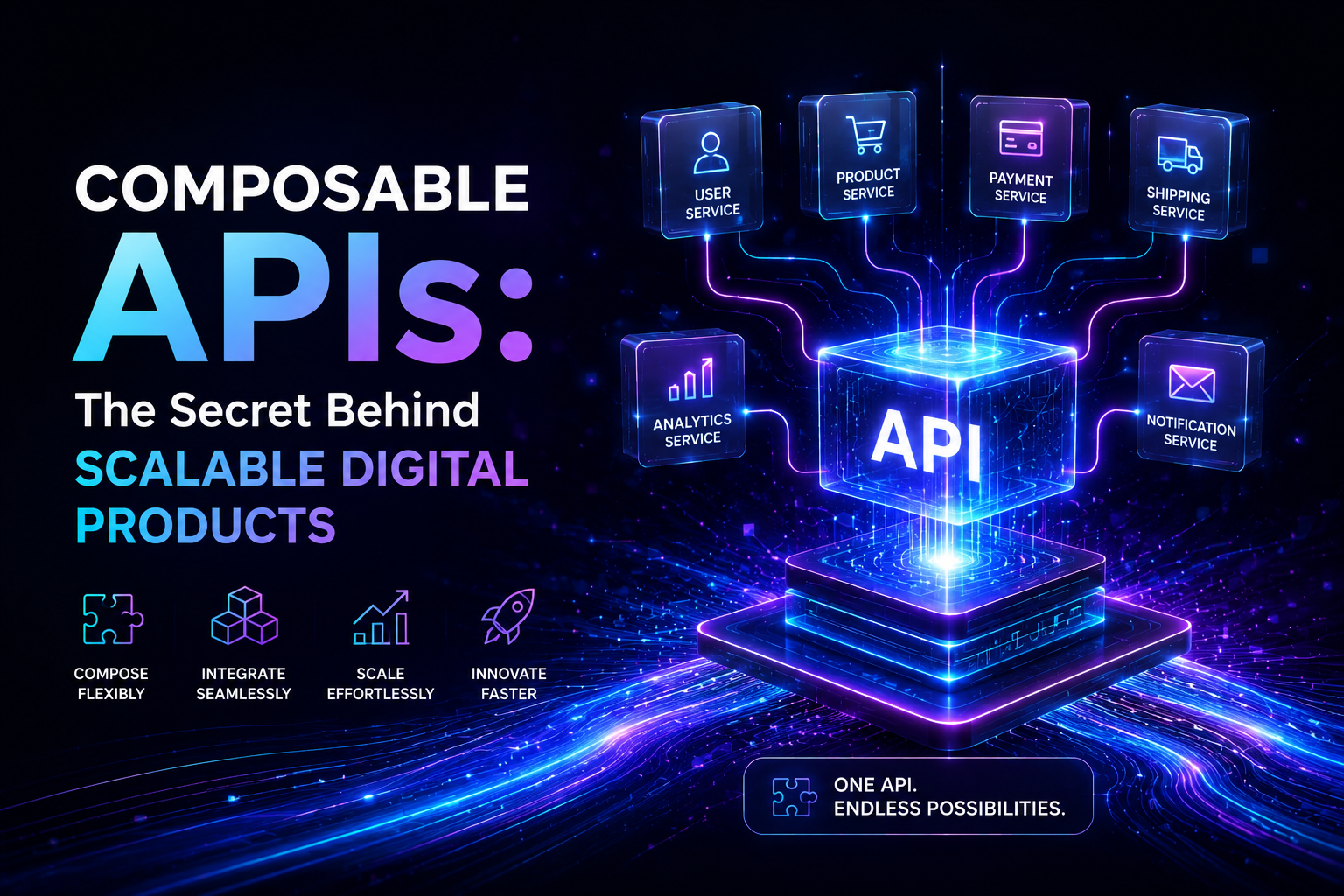
Instead of one large application managing everything internally, functionality is divided into smaller API-based services such as:
- Authentication API
- Payment API
- Customer profile API
- Product catalog API
- Recommendation engine API
Applications dynamically combine these services to deliver user experiences.
This creates a modular and adaptive architecture.
Core Principles of Composable API Architecture
- API-First Design APIs are designed before implementation to ensure consistency and scalability.
- Modularity: Each API handles a specific business capability independently.
- Reusability: APIs can be reused across multiple products and workflows.
- Loose Coupling Services communicate via APIs without tight dependencies.
- Event-Driven Communication Composable systems often use real-time events and messaging for dynamic operations.
Composable APIs vs Traditional APIs
| Traditional APIs | Composable APIs |
|---|---|
| Often tightly coupled | Modular and reusable |
| Limited scalability | Independently scalable |
| Fixed workflows | Flexible compositions |
| Slower innovation cycles | Faster feature delivery |
| Monolithic integrations | Dynamic API ecosystems |
Composable APIs provide the flexibility required for modern digital products.
Enterprise Use Cases
eCommerce Platforms
Composable APIs power:
- Product catalogs
- Payments
- Inventory systems
- Personalized recommendations
This enables flexible customer experiences.
SaaS Platforms
SaaS companies use composable APIs to:
- Enable integrations
- Support modular product development
- Scale features independently
AI-Powered Applications
AI systems rely on APIs to:
- Access data
- Trigger workflows
- Integrate with enterprise systems
Composable APIs make AI integration faster and more scalable.
FinTech Platforms
Financial applications use composable APIs for:
- Payment processing
- Identity verification
- Fraud detection
- Open banking integrations
Benefits of Composable APIs
| Benefit | Impact |
|---|---|
| Agility | Faster feature development |
| Scalability | Independent service scaling |
| Reusability | Reduced development effort |
| Flexibility | Easy integration with new systems |
| Innovation | Supports rapid experimentation |
Composable APIs turn digital platforms into adaptive ecosystems.
Architecture of Composable API Systems
A modern composable API architecture typically includes:
- API gateway
- Microservices layer
- Event streaming systems
- Authentication and identity services
- Monitoring and observability tools
- Cloud-native infrastructure
This architecture supports resilient and scalable digital products.
Challenges Enterprises Must Address
API Governance
Organizations need:
- Standardized API policies
- Version management
- Access controls
Security Risks
Composable APIs require:
- Authentication and authorization
- Encryption
- API threat monitoring
Complexity Management
As API ecosystems grow, enterprises must manage:
- Service dependencies
- Monitoring and observability
- Documentation consistency
Performance Optimization
High-scale API environments require:
- Intelligent caching
- Load balancing
- Traffic optimization
Best Practices for Building Composable API Platforms
- Adopt API-first architecture
- Use microservices and modular design
- Implement centralized API governance
- Ensure strong security and monitoring
- Design APIs for reuse and scalability
Strategic API architecture is essential for long-term success.
How APISDOR Helps Build Composable API Ecosystems
At APISDOR, we help enterprises:
- Design composable API architectures
- Build scalable API ecosystems
- Integrate cloud, SaaS, and AI platforms
- Implement API security and governance frameworks
- Enable automation and real-time integrations
We focus on creating API-driven platforms that support innovation, scalability, and digital transformation.
FAQs: Composable APIs
Q1. What is a composable API?
A: A composable API is a modular, reusable API designed to expose specific business capabilities independently.
Q2. How are composable APIs different from traditional APIs?
A: Composable APIs are designed for reuse, scalability, and flexibility across digital ecosystems.
Q3. Are composable APIs suitable for enterprise applications?
A: Yes. They are ideal for scalable, cloud-native, and API-first enterprise architectures.
Q4. Can composable APIs support AI systems?
A: Absolutely. AI systems rely heavily on APIs for data access and workflow execution.
Q5. Is composable architecture secure?
A: Yes, when implemented with proper governance, authentication, and monitoring.
Conclusion
Composable APIs are becoming the secret behind scalable digital products in 2026. By enabling modular architectures, faster innovation, and seamless integrations, they empower enterprises to build adaptive and future-ready digital ecosystems.
Organizations that embrace composable API strategies will gain a significant advantage in agility, scalability, and customer experience.
With APISDOR as your technology partner, you can build composable API platforms that drive modern digital transformation and long-term business success.


