
Building AI-Driven Decision Systems for Real-Time Business Intelligence
Introduction
Modern enterprises generate enormous volumes of data every second—from customer interactions and operational systems to IoT devices and cloud applications. However, data alone does not create business value. The real advantage comes from the ability to analyze information instantly and make intelligent decisions in real time.
In 2026, organizations are increasingly investing in AI-driven decision systems to power real-time business intelligence (BI). These systems combine AI, automation, streaming data, and analytics to enable faster, smarter, and more predictive decision-making.
At APISDOR, we help enterprises design AI-driven decision architectures that transform raw data into actionable business intelligence at scale.
What Are AI-Driven Decision Systems?
AI-driven decision systems are platforms that use:
- Artificial Intelligence (AI)
- Machine Learning (ML)
- Real-time analytics
- Automation workflows
- Event-driven architectures
to continuously analyze data and automatically trigger intelligent actions.
Unlike traditional BI systems that focus mainly on reporting, AI-driven systems support:
- Predictive insights
- Automated recommendations
- Real-time operational decisions
- Adaptive workflows
This shifts business intelligence from passive dashboards to active, intelligent decision-making systems.
Why Real-Time Business Intelligence Matters in 2026
1. Faster Business Decisions
Modern businesses must respond instantly to:
- Market changes
- Customer behavior
- Security threats
- Operational anomalies
Delayed insights can lead to lost revenue and missed opportunities.
2. AI-Powered Competitive Advantage
AI-driven systems enable:
- Predictive analytics
- Intelligent forecasting
- Automated optimization
Organizations can make smarter decisions faster than competitors.
3. Growth of Real-Time Data Ecosystems
Enterprises now operate across:
- Cloud platforms
- SaaS applications
- IoT systems
- APIs and microservices
Real-time BI systems help unify and continuously process this data.
Core Components of AI-Driven Decision Systems
1. Real-Time Data Ingestion
Data is collected from:
- APIs and applications
- IoT sensors
- Databases and event streams
- User interactions
Streaming pipelines ensure low-latency data availability.
2. AI and Machine Learning Layer
This layer provides:
- Predictive analytics
- Pattern recognition
- Risk scoring
- Decision intelligence
AI models continuously learn and improve from incoming data.
3. Event-Driven Processing Engine
Event-driven systems:
- Detect triggers in real time
- Process events instantly
- Launch workflows automatically
This enables proactive business operations.
4. Workflow Orchestration and Automation
Automation platforms coordinate:
- Alerts and notifications
- System integrations
- Decision execution workflows
This converts intelligence into operational action.
5. Analytics and Visualization Layer
Dashboards provide:
- Real-time KPIs
- AI-generated insights
- Predictive trends
- Operational monitoring
This enables leadership teams to act confidently and quickly.
6. Governance and Security Framework
AI-driven systems require:
- Data governance
- Access control
- Explainable AI models
- Compliance monitoring
Trust and transparency are critical for enterprise adoption.
How AI Changes Traditional Business Intelligence
| Traditional BI | AI-Driven BI |
|---|---|
| Historical reporting | Real-time predictive insights |
| Manual analysis | Automated decision-making |
| Static dashboards | Dynamic and adaptive systems |
| Batch processing | Continuous data streaming |
| Reactive operations | Proactive intelligence |
AI transforms BI into an intelligent operational system.
Enterprise Use Cases
Real-Time Fraud Detection
AI systems:
- Analyze transactions instantly
- Detect suspicious activity
- Trigger automated risk workflows
Used heavily in banking and fintech environments.
Supply Chain Intelligence
AI-driven systems:
- Predict demand fluctuations
- Optimize inventory levels
- Detect logistics disruptions
This improves operational efficiency.
Customer Experience Personalization
AI enables:
- Real-time recommendations
- Dynamic pricing
- Intelligent customer engagement
This improves customer retention and revenue.
IT Operations and Monitoring
AI-powered decision systems:
- Detect anomalies
- Predict outages
- Trigger remediation workflows automatically
This creates self-healing infrastructure environments.
Healthcare and Diagnostics
Real-time AI systems assist with:
- Patient monitoring
- Risk detection
- Predictive healthcare analytics
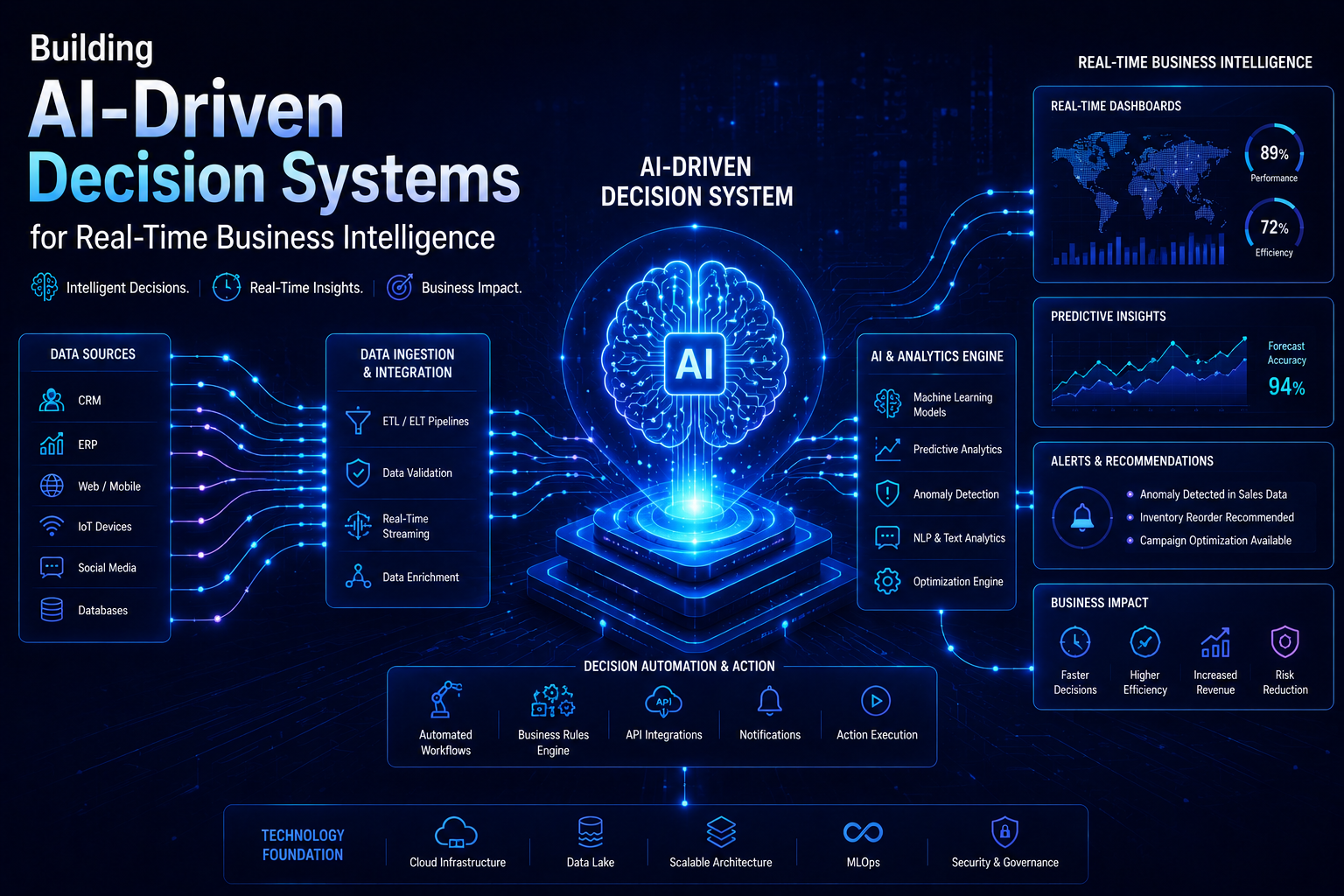
Architecture of Real-Time AI Decision Systems
A modern architecture typically includes:
- Data sources and APIs
- Event streaming platforms
- AI/ML engines
- Workflow orchestration systems
- Analytics dashboards
- Governance and monitoring tools
This creates a continuous intelligence loop for enterprise operations.
Benefits of AI-Driven Decision Systems
| Benefit | Impact |
|---|---|
| Speed | Faster business decisions |
| Accuracy | Data-driven intelligence |
| Automation | Reduced manual analysis |
| Scalability | Supports enterprise-scale operations |
| Agility | Real-time adaptability |
AI-driven BI systems transform enterprises into intelligent, responsive organizations.
Challenges Enterprises Must Address
Data Quality and Integration
AI depends on:
- Clean data
- Unified systems
- Consistent data pipelines
AI Governance
Organizations must ensure:
- Transparency
- Ethical AI usage
- Regulatory compliance
Infrastructure Complexity
Real-time systems require:
- Scalable cloud infrastructure
- High-performance streaming systems
- Reliable monitoring and observability
Change Management
Teams must adapt to:
- AI-assisted workflows
- Real-time operational models
- Data-driven decision culture
Best Practices for Building AI-Driven BI Systems
- Start with high-impact use cases
- Use API-first and event-driven architecture
- Implement scalable cloud-native infrastructure
- Maintain human oversight for critical decisions
- Continuously monitor AI performance and outcomes
Incremental adoption helps reduce complexity and risk.
How APISDOR Helps Build AI-Driven Decision Systems
At APISDOR, we help enterprises:
- Design real-time AI architectures
- Build streaming data pipelines and integrations
- Implement workflow automation platforms
- Integrate AI and analytics systems
- Ensure governance, security, and scalability
We focus on delivering intelligent systems that create measurable business value through real-time decision intelligence.
FAQs: AI-Driven Decision Systems
Q1. What is AI-driven business intelligence?
A: It combines AI, analytics, and real-time data processing to automate and optimize business decisions.
Q2. How is AI-driven BI different from traditional BI?
A: Traditional BI focuses on reporting historical data, while AI-driven BI provides predictive and real-time insights.
Q3. Can AI-driven systems operate in real time?
A: Yes. Modern architectures support streaming data and event-driven decision-making.
Q4. Are AI-driven decision systems secure?
A: Yes, when implemented with strong governance, monitoring, and access controls.
Q5. What industries benefit most from AI-driven BI?
A: Finance, healthcare, retail, manufacturing, logistics, and SaaS platforms are leading adopters.
Conclusion
AI-driven decision systems are redefining business intelligence in 2026. By combining AI, automation, and real-time data processing, enterprises can move from reactive reporting to proactive, intelligent operations.
Organizations that adopt AI-driven BI architectures will gain significant advantages in speed, efficiency, and innovation.
With APISDOR as your technology partner, you can build scalable, intelligent decision systems that transform data into real-time business outcomes and competitive advantage.


