
How AI Agents Are Reshaping Enterprise Software Architecture
Introduction
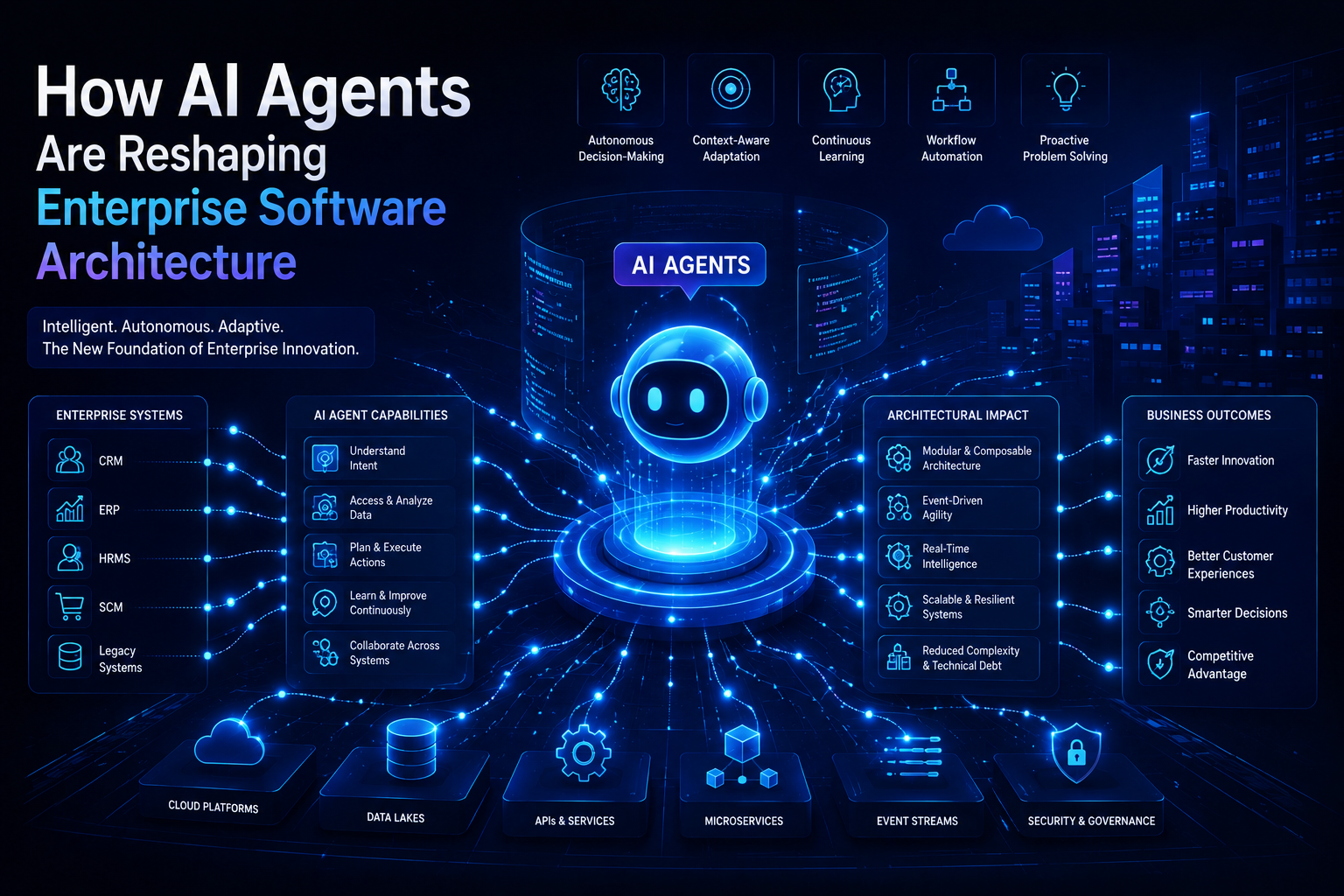
Enterprise software architecture is undergoing a major transformation. Traditional systems were designed around predefined workflows, static logic, and human-driven decision-making. However, the rise of AI agents is changing how enterprise applications are designed, integrated, and operated.
In 2026, organizations are moving beyond simple automation toward intelligent, autonomous systems capable of reasoning, adapting, and acting in real time. AI agents are becoming active participants within enterprise ecosystems—handling workflows, coordinating systems, analyzing data, and making contextual decisions.
At APISDOR, we help enterprises design AI-driven architectures that integrate intelligent agents into modern digital platforms, enabling scalability, agility, and innovation.
What Are AI Agents?
AI agents are intelligent software entities capable of:
- Understanding context and user intent
- Processing structured and unstructured data
- Making decisions based on goals and rules
- Interacting with APIs, systems, and applications
- Learning and improving over time
Unlike traditional bots or scripted automation, AI agents can operate autonomously and dynamically.
Why AI Agents Are Transforming Enterprise Architecture
1. Shift from Workflow Automation to Autonomous Operations
Traditional enterprise systems automate predefined tasks. AI agents automate:
- Decision-making
- Process orchestration
- Adaptive workflows
- Multi-system coordination
This fundamentally changes software architecture requirements.
2. Increasing Complexity of Enterprise Systems
Modern enterprises rely on:
- Microservices
- APIs
- Cloud-native applications
- Multi-cloud infrastructure
- Real-time data systems
AI agents help manage this complexity through intelligent orchestration.
3. Real-Time Business Expectations
Organizations now require:
- Instant responses
- Predictive insights
- Continuous optimization
AI agents enable applications to operate in real time.
How AI Agents Change Enterprise Software Design
1. Event-Driven Architecture Becomes Essential
AI agents operate best in event-driven systems where:
- Applications emit events continuously
- Agents react in real time
- Workflows adapt dynamically
This replaces rigid linear process design.
2. API-First Systems Become the Foundation
AI agents interact with:
- APIs
- SaaS platforms
- Internal enterprise systems
- Data pipelines
As a result, enterprises are adopting API-first architecture to ensure interoperability.
3. Microservices and Modular Systems Gain Importance
AI agents require modular environments where services can:
- Scale independently
- Communicate dynamically
- Be orchestrated intelligently
This accelerates the shift away from monolithic systems.
4. Intelligent Orchestration Layers Emerge
Traditional middleware is evolving into:
- AI-powered orchestration platforms
- Agent coordination systems
- Context-aware workflow engines
These layers become the “decision-making brain” of enterprise systems.
Core Architectural Components for AI-Agent Systems
1. Data and Context Layer
AI agents rely on:
- Real-time data streams
- Enterprise knowledge bases
- Context-aware memory systems
Without quality data, agents cannot make effective decisions.
2. AI and Reasoning Layer
This includes:
- Large Language Models (LLMs)
- Machine learning models
- Decision engines
These technologies power intelligence and reasoning.
3. Workflow and Automation Layer
Platforms such as:
- Workflow orchestration systems
- Low-code automation platforms
- Event-driven pipelines
allow agents to trigger and manage actions.
4. Integration and API Layer
APIs enable AI agents to:
- Access enterprise systems
- Retrieve data
- Execute operations securely
5. Governance and Security Layer
Enterprises must ensure:
- Access control
- Explainability of AI decisions
- Auditability and compliance
- Responsible AI governance
Security becomes even more critical in autonomous systems.
Enterprise Use Cases
AI-Powered IT Operations
AI agents can:
- Detect infrastructure anomalies
- Trigger remediation workflows
- Optimize cloud resources automatically
Intelligent Customer Experience Platforms
Agents provide:
- Personalized interactions
- Autonomous support resolution
- Dynamic recommendations
Finance and Risk Automation
AI agents:
- Detect fraud patterns
- Analyze transactions in real time
- Automate compliance checks
Supply Chain and Logistics
Agents help:
- Predict disruptions
- Optimize inventory
- Coordinate logistics operations
Enterprise Knowledge Management
AI agents can:
- Retrieve contextual information
- Summarize enterprise knowledge
- Assist employees in real time
Benefits of AI-Agent Architectures
| Benefit | Impact |
|---|---|
| Intelligence | Context-aware decision-making |
| Scalability | Handles complex enterprise environments |
| Automation | Reduces manual intervention |
| Agility | Faster response to business changes |
| Innovation | Enables adaptive digital systems |
AI agents transform software from static applications into living, intelligent systems.
Challenges Enterprises Must Solve
Governance and Trust
Organizations must ensure:
- Transparency in AI decisions
- Human oversight where necessary
- Ethical AI usage
Integration Complexity
AI agents must connect with legacy systems and distributed environments.
Security Risks
Autonomous systems require:
- Secure APIs
- Identity management
- Continuous monitoring
Infrastructure Scalability
AI-driven workloads demand:
- High-performance computing
- Scalable cloud-native infrastructure
- Real-time data architectures
Best Practices for AI-Agent Adoption
- Start with high-value business use cases
- Build API-first and event-driven architectures
- Use modular and composable systems
- Maintain human-in-the-loop governance
- Continuously monitor AI performance and outcomes
Incremental adoption ensures sustainable transformation.
How APISDOR Helps Enterprises Build AI-Agent Architectures
At APISDOR, we help organizations:
- Design AI-native enterprise architectures
- Integrate AI agents with enterprise systems and APIs
- Build scalable automation and orchestration platforms
- Implement governance and security frameworks
- Optimize AI workflows for performance and business outcomes
We focus on creating future-ready enterprise ecosystems powered by intelligent automation.
FAQs: AI Agents and Enterprise Architecture
Q1. What is the difference between AI agents and traditional automation?
A: Traditional automation follows fixed rules, while AI agents make contextual decisions and adapt dynamically.
Q2. Are AI agents suitable for enterprise-scale systems?
A: Yes. Modern architectures support scalable AI-agent deployment across enterprise environments.
Q3. Do AI agents replace enterprise applications?
A: No. They enhance and orchestrate applications rather than replacing them entirely.
Q4. Are AI-agent systems secure?
A: Yes, when implemented with proper governance, API security, and monitoring.
Q5. Which industries benefit most from AI agent architectures?
A: Finance, healthcare, retail, logistics, SaaS, and manufacturing are among the leading adopters.
Conclusion
AI agents are reshaping enterprise software architecture by introducing intelligence, adaptability, and autonomous decision-making into digital systems. As enterprises move toward AI-native operations, architecture must evolve to support event-driven workflows, modular services, and intelligent orchestration.
In 2026 and beyond, organizations that embrace AI-agent architectures will gain significant advantages in agility, efficiency, and innovation.
With APISDOR as your technology partner, you can build intelligent enterprise ecosystems designed for the next generation of digital transformation.


