
Building Scalable Enterprise Integrations Using Low-Code Platforms
Introduction
Modern enterprises rely on dozens—sometimes hundreds—of applications to run their operations. From CRM and ERP systems to cloud services and AI platforms, the challenge is no longer adopting technology but integrating it effectively.
Traditional integration methods often require complex development, long timelines, and high maintenance costs. In 2026, organizations are increasingly turning to low-code integration platforms to build scalable, flexible, and efficient integration architectures.
At APISDOR, we help enterprises leverage low-code platforms to design integration ecosystems that scale with business growth while maintaining governance and performance.
What Are Low-Code Integration Platforms?
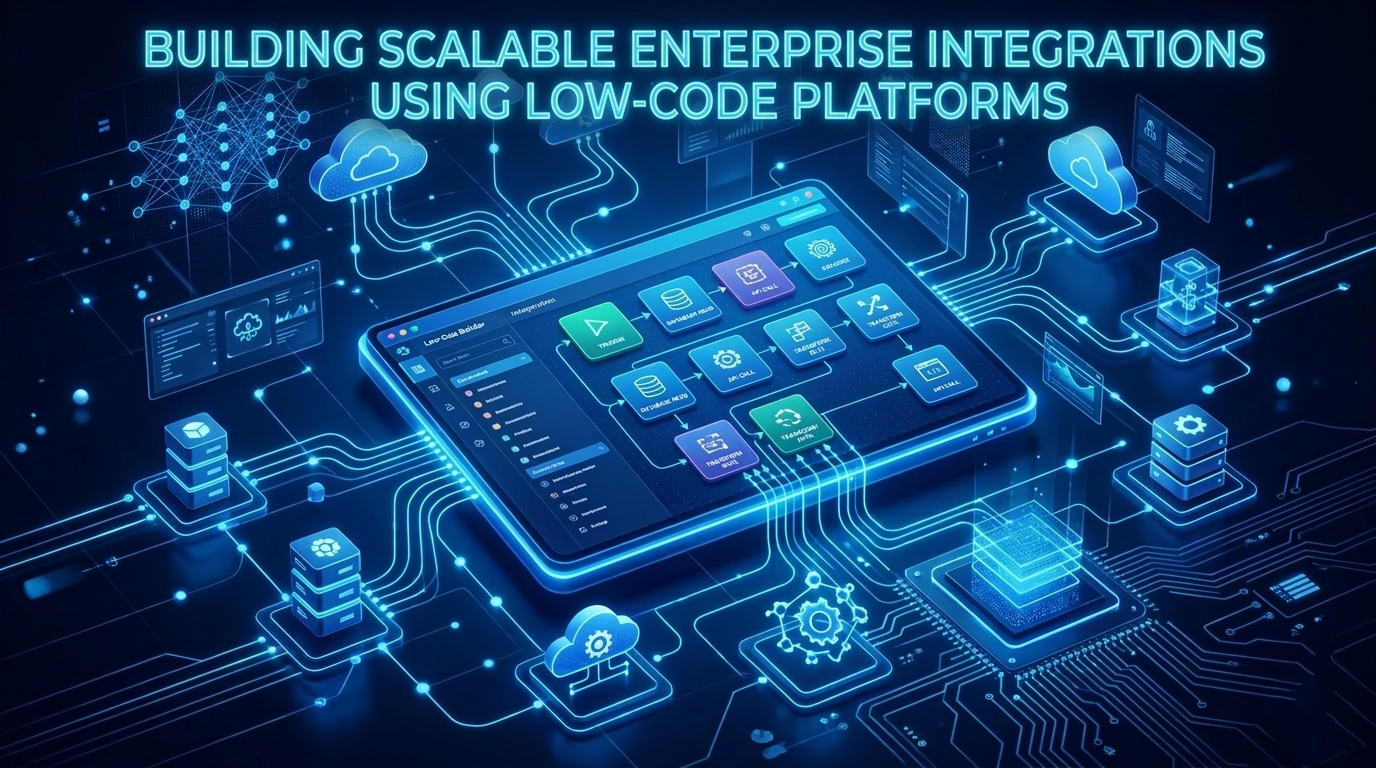
Low-code integration platforms provide visual tools and prebuilt connectors that allow developers and IT teams to connect applications, automate workflows, and orchestrate data exchanges with minimal manual coding.
Key capabilities include:
- Drag-and-drop workflow design
- API and webhook integrations
- Event-driven automation
- Data transformation and mapping
- Built-in monitoring and error handling
These platforms enable enterprises to build integrations faster and more efficiently.
Why Scalability Matters in Enterprise Integrations
As organizations grow, integration requirements become more complex. Scalable integration architecture ensures that systems can:
- Handle increasing data volumes
- Support new applications and services
- Enable real-time communication between systems
- Maintain performance under heavy workloads
Without scalable integration frameworks, enterprises risk bottlenecks, data inconsistencies, and operational delays.
Advantages of Low-Code Integration Platforms
1. Faster Development Cycles
Low-code platforms reduce development time by allowing teams to build integrations visually rather than writing large volumes of code.
This accelerates:
- Application onboarding
- Workflow automation
- System connectivity
Enterprises can deploy integrations in weeks instead of months.
2. Reduced Complexity
Traditional integrations often involve complex middleware and custom scripts.
Low-code solutions simplify the process by providing:
- Prebuilt connectors
- Standardized integration templates
- Reusable workflows
This reduces operational complexity and maintenance overhead.
3. Improved Collaboration Between Teams
Low-code environments allow business teams and developers to collaborate on workflow design.
This ensures:
- Better alignment between IT and business requirements
- Faster iteration cycles
- Clear visibility into integration logic
4. Scalable Architecture
Modern low-code platforms support enterprise-scale workloads through:
- Cloud-native infrastructure
- API-first architectures
- Event-driven processing
- Distributed workflow execution
This ensures integrations remain stable even as demand increases.
Core Components of Scalable Low-Code Integration
API Connectivity
APIs serve as the backbone of modern integrations. Low-code platforms simplify API consumption and management.
Workflow Orchestration
Workflow orchestration ensures that data flows seamlessly across systems and processes.
Data Transformation
Enterprises often need to convert data formats between systems. Low-code tools provide built-in transformation capabilities.
Monitoring and Observability
Scalable integrations require visibility into performance, failures, and usage patterns.
Low-code platforms provide dashboards, logs, and alerts to maintain system reliability.
Real-World Enterprise Use Cases
CRM and ERP Integration
Automating data exchange between customer management and financial systems ensures consistent business data across departments.
Cloud Application Synchronization
Low-code platforms enable seamless integration between SaaS applications such as marketing, sales, and support platforms.
Supply Chain Automation
Integrations between logistics systems, inventory platforms, and analytics tools allow organizations to optimize supply chain operations.
AI and Analytics Pipelines
Data pipelines built with low-code platforms enable real-time analytics and AI-driven decision-making.
Low-Code vs Traditional Integration
| Aspect | Traditional Integration | Low-Code Integration |
|---|---|---|
| Development Time | Long | Fast |
| Maintenance | Complex | Simplified |
| Flexibility | Moderate | High |
| Cost | High | Lower |
| Scalability | Requires custom architecture | Built-in scalability |
Low-code integration platforms enable enterprises to deliver integrations faster while maintaining enterprise-grade reliability.
Best Practices for Building Scalable Integrations
- Design integrations using API-first architecture
- Implement modular and reusable workflows
- Use event-driven triggers for real-time operations
- Establish monitoring and alert systems
- Maintain strong security and governance policies
These practices ensure integrations remain efficient, secure, and scalable.
How APISDOR Supports Enterprise Integration
At APISDOR, we help organizations:
- Design scalable integration architectures
- Implement low-code integration platforms
- Connect cloud, SaaS, and legacy systems
- Enable automation and AI-driven workflows
- Ensure governance, compliance, and performance
Our approach focuses on building future-ready integration ecosystems that support long-term digital transformation.
FAQs: Low-Code Enterprise Integrations
Q1. Are low-code platforms suitable for large enterprises?
A: Yes. Many modern low-code platforms are designed specifically for enterprise-scale workloads.
Q2. Do low-code integrations replace developers?
A: No. They empower developers to build integrations faster and focus on complex business logic.
Q3. Are low-code integrations secure?
A: With proper governance, authentication, and monitoring, low-code platforms provide enterprise-grade security.
Q4. Can low-code platforms integrate legacy systems?
A: Yes. Many platforms provide connectors and APIs to integrate legacy infrastructure.
Q5. How quickly can enterprises implement low-code integrations?
A: Initial integrations can often be deployed within weeks, depending on system complexity.
Conclusion
Scalable integration is essential for modern enterprises navigating digital transformation. Low-code platforms provide the speed, flexibility, and scalability required to connect complex technology ecosystems.
By adopting low-code integration strategies, organizations can reduce development effort, accelerate innovation, and build resilient digital infrastructures.
With APISDOR as your integration partner, enterprises can confidently design scalable integration architectures that power business growth and technological advancement.


