
Low-Code Integration Platforms for Digital Transformation
Introduction
Digital transformation is no longer driven by standalone applications—it is powered by how well systems, data, and processes are connected. In 2026, enterprises are managing dozens (sometimes hundreds) of applications across cloud, on-premise, and SaaS environments.
This growing complexity has made low-code integration platforms a critical foundation for digital transformation. These platforms enable organizations to integrate systems faster, automate workflows, and respond quickly to business change—without relying solely on heavy custom development.
At APISDOR, we help enterprises leverage low-code integration platforms to create connected, agile, and future-ready digital ecosystems.
What Are Low-Code Integration Platforms?
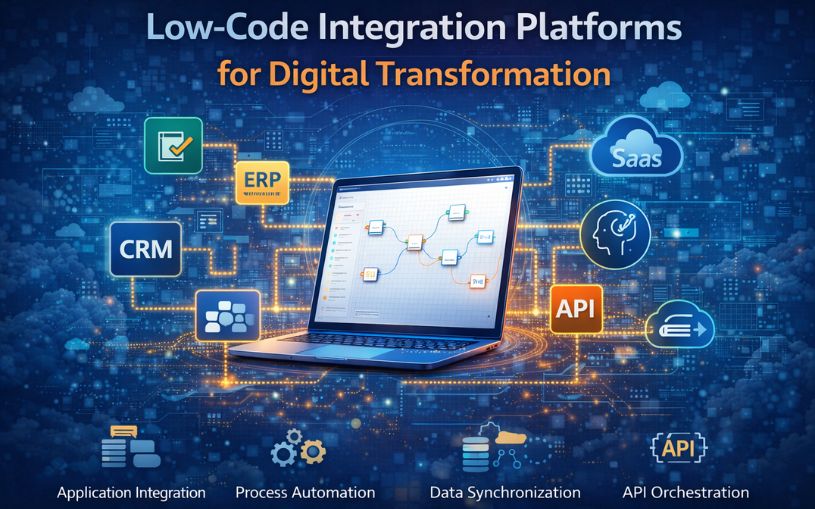
Low-code integration platforms provide visual tools to:
- Connect applications, APIs, and data sources
- Orchestrate workflows across systems
- Automate business processes
- Enable real-time and event-driven integrations
They reduce the need for manual coding while still supporting enterprise-grade scalability, security, and extensibility.
Why Integration Is Central to Digital Transformation
Digital transformation initiatives often fail due to:
- Data silos
- Disconnected systems
- Slow integration cycles
- High dependency on scarce integration skills
Low-code integration platforms address these challenges by acting as a central integration and automation layer across the enterprise.
Key Benefits of Low-Code Integration Platforms
1. Faster Time to Value
Visual workflows and prebuilt connectors allow enterprises to:
- Launch integrations in weeks instead of months
- Rapidly onboard new applications
- Adapt quickly to changing business needs
Speed is a competitive advantage in 2026.
2. Reduced Complexity and Cost
Low-code platforms:
- Minimize custom integration code
- Reduce maintenance overhead
- Lower dependency on specialized developers
This leads to a lower total cost of ownership.
3. Improved Business–IT Collaboration
Business teams and IT teams can collaborate on:
- Process design
- Workflow logic
- Integration validation
This reduces misalignment and accelerates delivery.
4. Scalability and Enterprise Readiness
Modern low-code integration platforms support:
- High-volume transaction processing
- API management and governance
- Cloud-native and hybrid deployments
- Role-based access and security controls
They scale with enterprise growth.
Common Use Cases in Digital Transformation
Application & SaaS Integration
- CRM, ERP, HR, and finance systems
- Cloud and on-premise applications
Workflow Automation
- Approval flows
- Notifications and alerts
- Cross-department processes
Data Synchronization
- Real-time and batch data movement
- ETL and data pipelines
API Orchestration
- Microservices coordination
- External partner integrations
AI & Intelligent Automation
- Orchestrating AI agents
- Human-in-the-loop workflows
- Decision automation
Low-Code Integration vs Traditional Integration
| Aspect | Traditional Integration | Low-Code Integration |
|---|---|---|
| Development Speed | Slow | Fast |
| Skill Dependency | High | Moderate |
| Maintenance | Complex | Simplified |
| Flexibility | Limited | High |
| Business Agility | Low | High |
Low-code integration is not about replacing developers—it’s about enabling smarter delivery.
Role of Low-Code Integration in Digital Transformation
Low-code integration platforms enable enterprises to:
- Break down silos
- Enable real-time operations
- Improve customer experience
- Support innovation initiatives
- Build scalable digital foundations
They act as the connective tissue of modern digital enterprises.
Governance, Security, and Control
Enterprise-ready platforms provide:
- Secure credential management
- Role-based access control
- Logging and audit trails
- Error handling and retries
- Compliance support
Digital transformation without governance creates risk—low-code platforms balance speed and control.
How APISDOR Helps Enterprises Succeed
At APISDOR, we help organizations:
- Design integration-first digital architectures
- Select the right low-code integration platforms
- Build scalable, reusable workflows
- Integrate AI, automation, and cloud services
- Ensure security, compliance, and performance
Our focus is on business outcomes—not just integrations.
Best Practices for Adopting Low-Code Integration Platforms
- Start with high-impact integration use cases
- Design reusable and modular workflows
- Implement monitoring and error handling early
- Align integrations with business KPIs
- Combine low-code with custom extensions when needed
Strategic adoption ensures long-term transformation success.
FAQs: Low-Code Integration Platforms
Q1. Are low-code integration platforms suitable for large enterprises?
A: Yes. Modern platforms are designed for enterprise-scale workloads.
Q2. Do they replace traditional ESB or middleware?
A: They often complement or modernize traditional integration layers.
Q3. Are low-code integrations secure?
A: Yes, when implemented with proper governance and security controls.
Q4. Can developers still write custom logic?
A: Absolutely. Most platforms support custom code where required.
Q5. How quickly can enterprises see results?
A: Many organizations see value within weeks, not months.
Conclusion
In 2026, digital transformation success depends on how quickly and intelligently enterprises can integrate systems and processes. Low-code integration platforms make this possible by combining speed, flexibility, and enterprise-grade control.
With APISDOR as your digital transformation partner, low-code integration becomes a strategic accelerator—helping you build connected, agile, and future-ready enterprises.


