
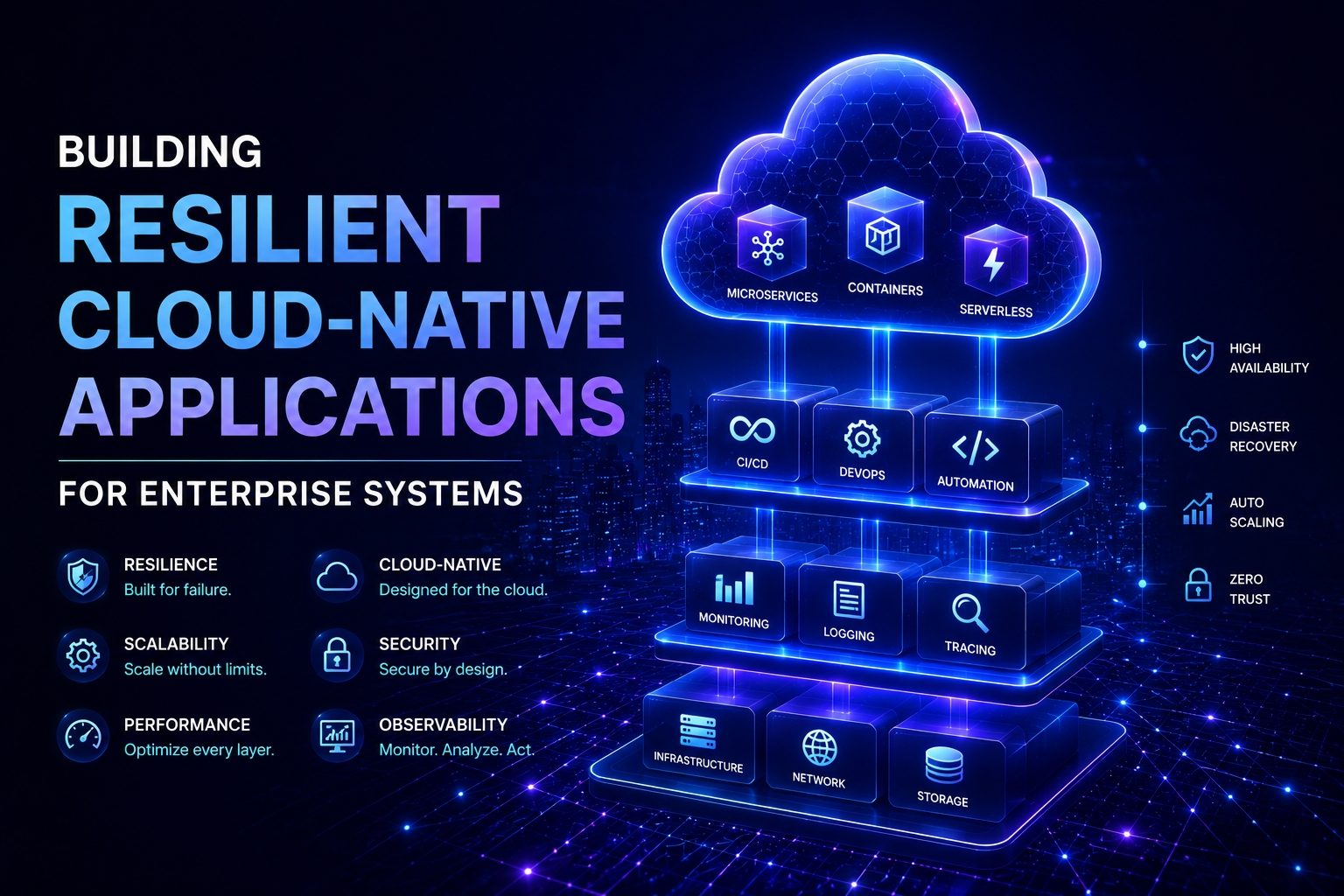
Building Resilient Cloud-Native Applications for Enterprise Systems
Introduction
As enterprises accelerate digital transformation initiatives, application resilience has become a business-critical requirement. Modern organizations operate in highly distributed environments where downtime, service disruptions, and performance bottlenecks can directly impact revenue, customer experience, and operational efficiency.
Traditional application architectures often struggle to meet the demands of today’s dynamic digital landscape. This is why enterprises are increasingly adopting cloud-native architectures designed for scalability, fault tolerance, and continuous availability.
In 2026, building resilient cloud-native applications is no longer just an IT objective—it’s a strategic business imperative.
At APISDOR, we help enterprises design and implement cloud-native systems that remain reliable, secure, and scalable even under unpredictable workloads and operational challenges.
What Are Cloud-Native Applications?
Cloud-native applications are software systems specifically designed to leverage cloud computing capabilities.
Unlike traditional monolithic applications, cloud-native solutions are built using:
- Microservices architectures
- Containers
- Kubernetes orchestration
- API-first design
- DevOps automation
- Event-driven systems
These technologies enable applications to scale dynamically while maintaining high availability and resilience.
Why Resilience Matters for Enterprise Applications
Enterprise systems support critical business functions such as:
- Customer engagement
- Financial operations
- Supply chain management
- Healthcare services
- Internal business processes
Even brief outages can result in:
- Revenue loss
- Customer dissatisfaction
- Compliance risks
- Operational disruption
Resilient applications minimize these risks by ensuring continuous operation despite failures or unexpected events.
Core Principles of Resilient Cloud-Native Architecture
1. Fault Tolerance
Cloud-native systems are designed to continue operating even when individual components fail.
Key practices include:
- Service redundancy
- Automated failover
- Distributed deployments
- Self-healing infrastructure
Failures are isolated rather than causing system-wide outages.
2. Scalability
Enterprise workloads fluctuate constantly.
Cloud-native applications support:
- Horizontal scaling
- Automatic resource allocation
- Elastic infrastructure
This ensures applications can handle demand spikes without performance degradation.
3. High Availability
Resilient systems maintain service availability through:
- Multi-region deployments
- Load balancing
- Redundant services
- Traffic routing strategies
The goal is to minimize downtime and ensure business continuity.
4. Observability
Organizations need complete visibility into application behavior.
Observability includes:
- Monitoring
- Logging
- Distributed tracing
- Performance analytics
This helps teams identify and resolve issues proactively.
5. Security by Design
Resilience also includes security.
Cloud-native applications should implement:
- Zero Trust principles
- Identity and access management
- API security
- Continuous vulnerability monitoring
Secure systems are more resilient against cyber threats.
Essential Components of Resilient Cloud-Native Applications
Microservices Architecture
Applications are divided into independent services that:
- Scale individually
- Deploy independently
- Recover independently
This reduces the impact of failures.
Containers
Containers package applications with their dependencies, ensuring:
- Consistent deployments
- Portability
- Faster recovery
Containerization simplifies application management across environments.
Kubernetes Orchestration
Kubernetes provides:
- Automated deployment
- Self-healing capabilities
- Service discovery
- Resource optimization
It acts as the backbone of modern cloud-native platforms.
API-First Integration
Enterprise systems rely heavily on APIs to connect:
- Internal services
- SaaS applications
- Third-party platforms
- AI systems
Well-designed APIs improve flexibility and resilience.
Event-Driven Architecture
Event-driven systems allow applications to:
- React to real-time events
- Process workloads asynchronously
- Reduce dependencies between services
This improves scalability and fault tolerance.
Building Resilience Through DevOps and Automation
Continuous Integration and Continuous Deployment (CI/CD)
Automated pipelines enable:
- Frequent releases
- Faster issue resolution
- Reduced deployment risks
This supports continuous improvement and operational stability.
Infrastructure as Code (IaC)
IaC allows teams to:
- Automate infrastructure provisioning
- Maintain consistency across environments
- Recover systems quickly
This improves reliability and disaster recovery capabilities.
Automated Testing
Resilient systems require:
- Unit testing
- Integration testing
- Performance testing
- Chaos engineering
Testing ensures applications can withstand failures and heavy workloads.
Enterprise Use Cases
Financial Services Platforms
Cloud-native architectures support:
- Real-time transaction processing
- High availability
- Regulatory compliance
eCommerce Applications
Resilience helps:
- Handle peak shopping periods
- Maintain customer experience
- Prevent revenue loss during traffic spikes
Healthcare Systems
Cloud-native applications enable:
- Secure patient data access
- Continuous service availability
- Real-time analytics
SaaS Platforms
Modern SaaS providers use cloud-native architectures to:
- Scale globally
- Deploy features rapidly
- Ensure service reliability
Common Challenges
Managing Distributed Systems
Microservices introduce complexity that requires strong monitoring and governance.
Data Consistency
Distributed applications must balance:
- Availability
- Consistency
- Performance
Security Risks
Cloud-native environments increase the need for:
- API protection
- Identity management
- Continuous monitoring
Operational Complexity
Organizations need skilled teams and automation tools to manage modern infrastructure effectively.
Best Practices for Building Resilient Cloud-Native Applications
- Design for Failure
Assume failures will occur and architect systems to recover automatically. - Implement Multi-Region Deployment
Distribute workloads across multiple regions to improve availability. - Use Event-Driven Architectures
Reduce dependencies and improve scalability through asynchronous communication. - Invest in Observability
Monitoring and analytics are essential for proactive issue detection. - Automate Everything Possible
Automation improves consistency, speed, and reliability across the application lifecycle.
How APISDOR Helps Build Resilient Cloud-Native Systems
At APISDOR, we help enterprises:
- Design cloud-native architectures
- Modernize legacy applications
- Implement Kubernetes and container platforms
- Build CI/CD and automation pipelines
- Integrate APIs and microservices
- Ensure governance, security, and compliance
Our goal is to help organizations create resilient enterprise systems that support long-term growth and innovation.
Benefits of Resilient Cloud-Native Applications
| Benefit | Business Impact |
|---|---|
| High Availability | Reduced downtime and business disruption |
| Scalability | Handles growing workloads efficiently |
| Agility | Faster deployment and innovation |
| Reliability | Improved customer experience |
| Security | Stronger protection against threats |
| Cost Efficiency | Optimized cloud resource utilization |
FAQs: Resilient Cloud-Native Applications
Q1. What makes a cloud-native application resilient?
A: A resilient cloud-native application can continue operating during failures through redundancy, automation, and self-healing capabilities.
Q2. Why is Kubernetes important for resilience?
A: Kubernetes automates deployment, scaling, and recovery, helping maintain application availability.
Q3. Can legacy applications become cloud-native?
A: Yes. Many organizations modernize legacy systems gradually, using APIs, containers, and microservices.
Q4. How does observability improve resilience?
A: Observability provides real-time insights into system health, helping teams detect and resolve issues quickly.
Q5. Are cloud-native applications more secure?
A: When designed properly with Zero Trust principles, continuous monitoring, and strong access controls, cloud-native applications can offer enhanced security.
Conclusion
Building resilient cloud-native applications is essential for enterprises seeking to thrive in an increasingly digital and competitive landscape. By combining microservices, containers, APIs, automation, and cloud-native infrastructure, organizations can create systems that remain scalable, secure, and available under any conditions.
In 2026 and beyond, resilience will be one of the defining characteristics of successful enterprise platforms.
With APISDOR as your technology partner, you can build cloud-native enterprise applications that deliver reliability, agility, and long-term business value while supporting your digital transformation journey.


